
During a quarterly chart audit, a lead therapist finds several fractions that record only the date, treatment machine, dose delivered, and fraction number, while the signed prescription and plan sheet are filed separately. Which additional treatment details best complete the documentation for each fraction?
Select an answer to reveal the explanation.
Short Explanation
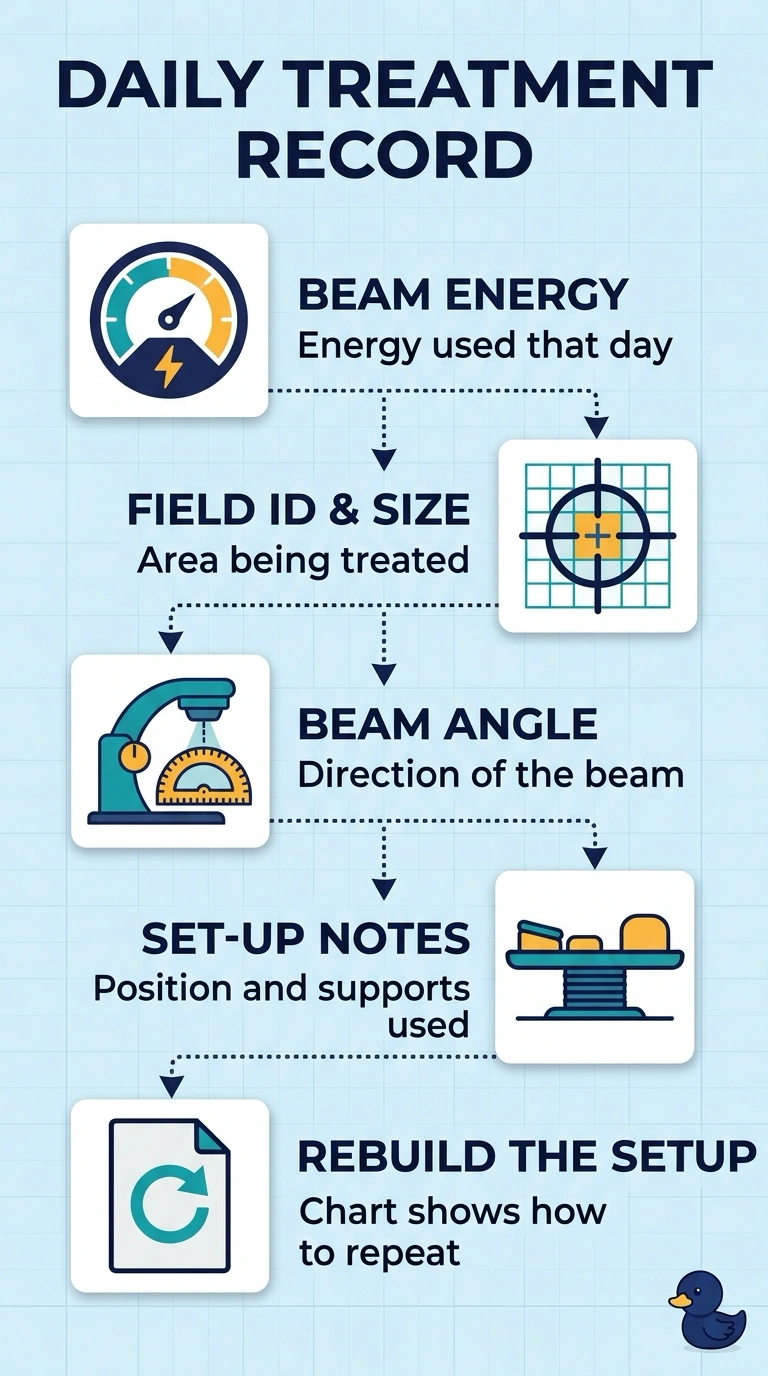
Your fraction note should be a snapshot of that day’s treatment, so you can tell how it was actually delivered. Along with the date, machine, dose, and fraction number, add the beam energy, field identity, size and angle, and that day’s set-up.
Full Explanation
Complete fraction-level documentation identifies how each treatment was actually delivered: record the beam energy, field identity, field size and angle, and the set-up used that day. These details support reconstruction and review of the delivered treatment instead of requiring staff to rely on the separately filed prescription or plan sheet. Documenting field identity, dimensions and angle, and that day’s set-up omits beam energy, so the delivered beam is not fully characterized. Recording beam energy, field identity and size, and the fraction’s positioning leaves out the field angle; positioning does not replace documentation of the treatment field’s angle. Recording beam energy, field ID, size and angle according to the plan’s standard set-up includes the field parameters but does not document the set-up actually used for that fraction. An exam caveat is that a prescription or approved plan establishes intended treatment, whereas each fraction record should reflect delivery details and any day-specific set-up. In practice, compare a sample of fraction notes with the treatment delivery record or machine log, and verify that the documented field parameters and set-up match that day’s treatment.