
A patient reports a transdermal pain patch on the left shoulder that is labeled to contain metallic foil, a metal fragment that struck one eye years ago with no record of follow-up imaging, and an old hip implant whose paperwork was left at home. The technologist is completing MRI screening before the exam. Which safety steps must be finished before the patient enters the magnet room?
Select an answer to reveal the explanation.
Short Explanation
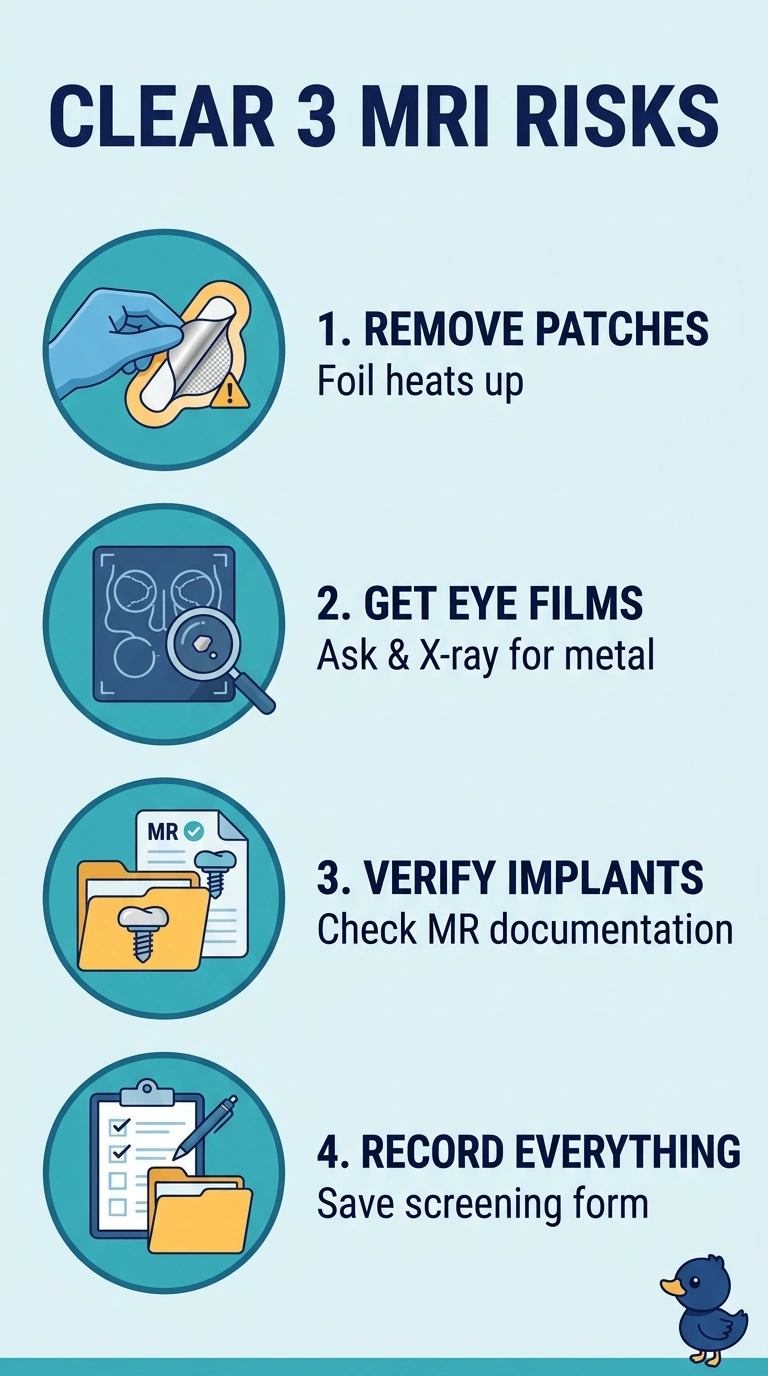
Before you let the patient enter the magnet room, remove the foil-containing patch, obtain orbital films to check for metal in the eye, and verify the hip implant’s MR documentation. Treat each hazard like a separate safety checkpoint—all must be cleared first.
Full Explanation
The correct approach completes all three safety checks before the patient enters the magnet room: remove the patch because its label identifies metallic foil, obtain orbital films because a prior metal fragment injury has no documented follow-up imaging, and verify the hip implant’s MR conditions using reliable documentation. Implant appearance on radiographs may help identify a device, but does not by itself establish its MR conditions; allowing entry before those conditions are verified therefore fails the required implant check. A remote injury history cannot establish that no fragment remains, so it does not replace orbital imaging when follow-up is undocumented. Likewise, confirming the orbit and implant does not make a foil-containing patch safe to bring into the magnet room; it must be removed before entry. Exam caveat: a negative history or absence of symptoms is not equivalent to documented clearance after a potentially penetrating metallic eye injury. Practical check: reconcile the patch label and implant records, document the orbital imaging result, and confirm that all required items are resolved before authorizing magnet-room access.