
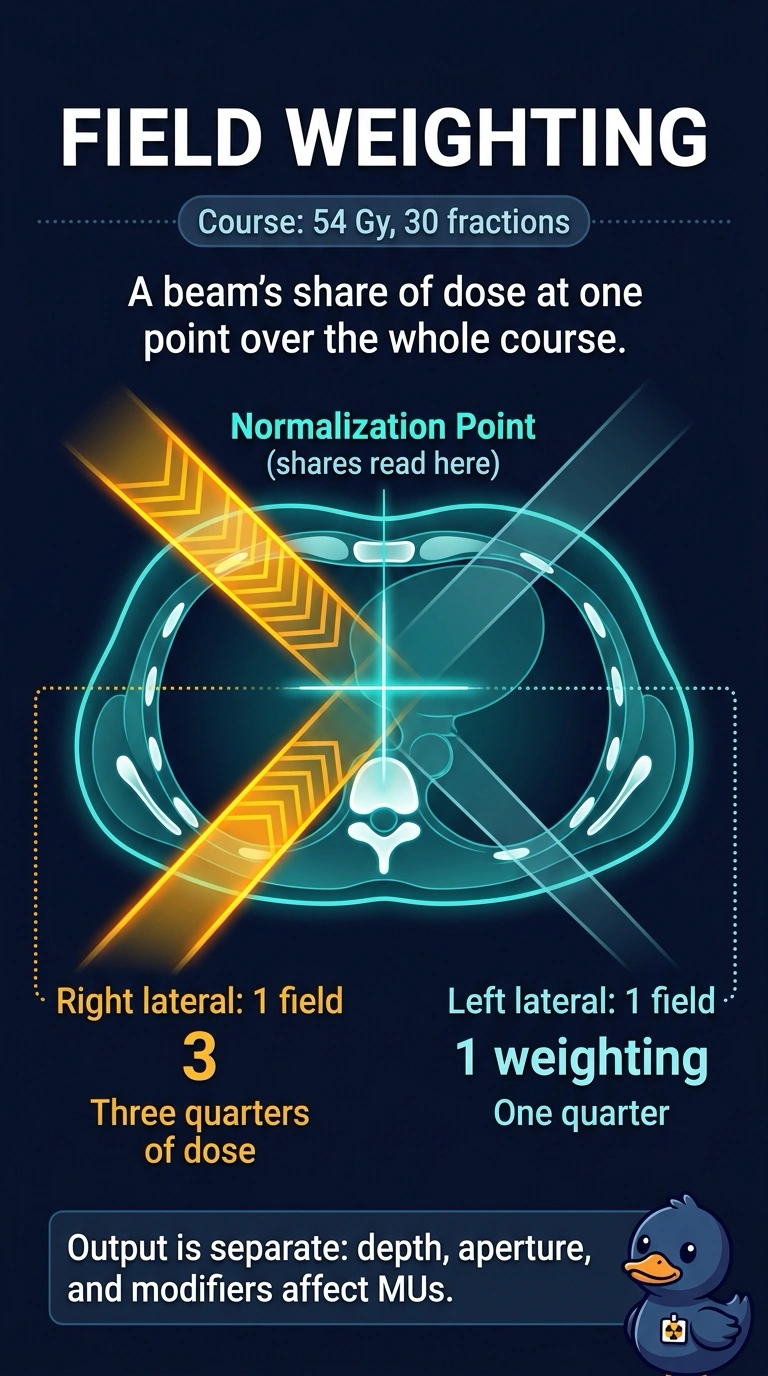
A course is prescribed as 54 Gy in 30 fractions with a midline normalization and a 3:1 weighting favoring the right lateral field. The two lateral fields enter at different depths and use different MLC aperture sizes, so their beam settings are not comparable. Which statement correctly interprets the 3:1 field weighting in this prescription?
Select an answer to reveal the explanation.
Short Explanation
Weighting tells you how the beams share the dose at the point where the plan is normalized, not which beam carries the bigger machine settings. With different depths and apertures, the monitor units needed to achieve each dose contribution can differ.
Full Explanation
A weighting ratio describes the relative dose contributions at the normalization point, so three to one means the right lateral contributes three quarters of the total and the left lateral one quarter, summed over the whole course. The planning system calculates the monitor units needed to achieve those contributions using the beam and patient geometry, including depth, aperture, and modifiers. The ratio does not mean the monitor units are in the same ratio, because monitor units depend on those factors. It also does not split the target into separate prescriptions: the beams contribute to one course normalized to a single point. Nor does the ratio specify aperture size; aperture and other beam settings affect the dose calculation and the monitor units needed. On the exam, weighting questions often pair a ratio with unequal beam conditions to test whether you distinguish dose contribution from machine settings. Confirm the normalization point and the dose contribution from each beam when interpreting the plan.