
A palliative plan for a sternum lesion is prescribed as 2 Gy per fraction at the midplane, and the plan record explicitly defines the anterior field weight of 1.5 and posterior field weight of 0.5 as normalized dose contributions to that prescription. During the check a therapist asks how those weighting numbers translate into the daily dose. Which dose split between the two fields does that notation describe?
Select an answer to reveal the explanation.
Short Explanation
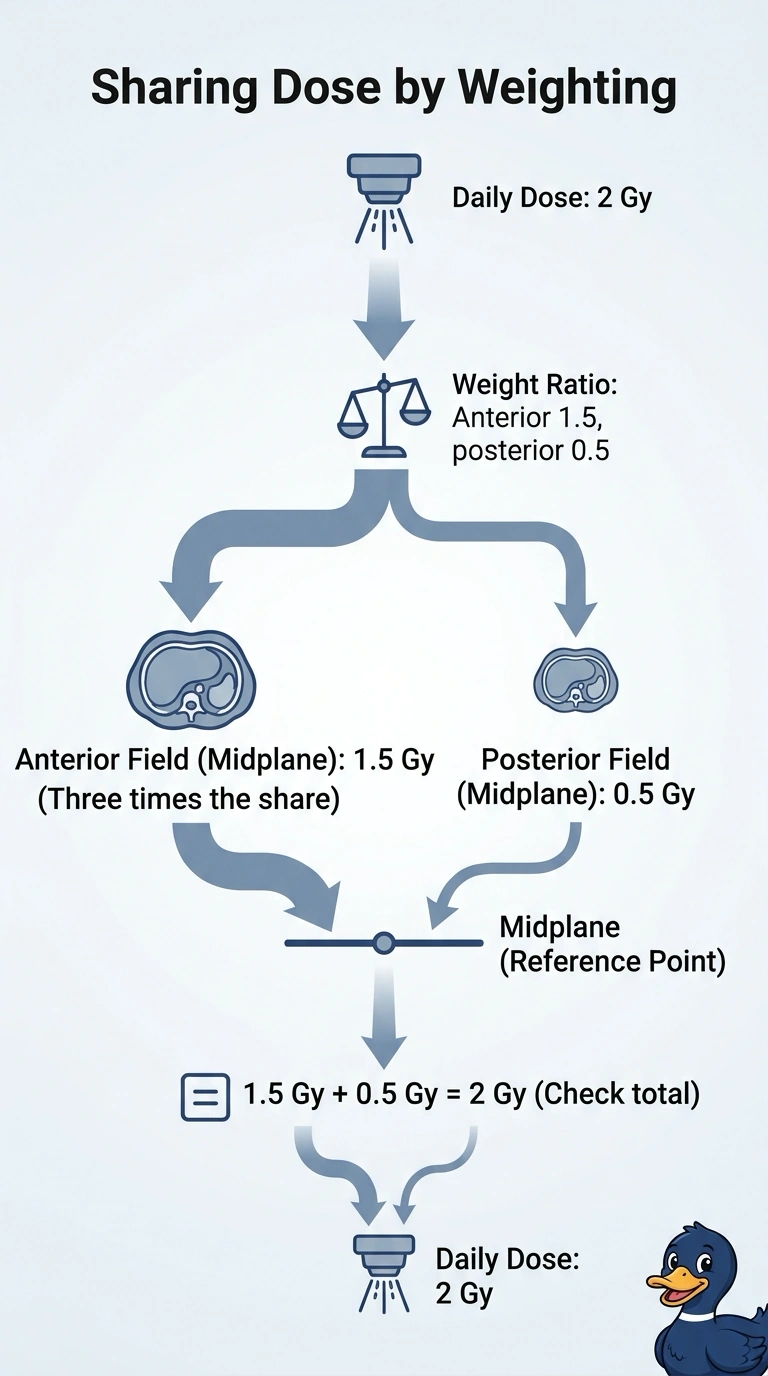
You’re reading the weights as 1.5 Gy from the anterior field and about 0.5 Gy from the posterior at the reference point, adding up to the prescribed 2 Gy. Like splitting a bill, the shares add up to the total.
Full Explanation
Here, field weighting expresses how the prescribed dose at a reference point is shared between the beams. The normalized weights of 1.5 and 0.5 for a 2 Gy fraction describe a three-to-one split, giving 1.5 Gy from the anterior field and 0.5 Gy from the posterior field. Check that the shares add back to the prescription. Giving both fields the full prescription doubles the dose at the reference point, which ignores the requirement that the weights distribute a fixed dose. Reading the numbers as field size confuses dose weighting with aperture design, since the block or leaf opening sets the shape. Splitting the prescription evenly between the beams ignores the stated three-to-one ratio. Weighting conventions can vary between departments, so use the convention defined in the plan record; in this scenario, the record explicitly defines the numbers as normalized dose contributions.