
During chart rounds, a thoracic plan shows the spinal cord dose held just below the department's cited TD5/5 limit for a short cord segment, and the team is comparing several serial organs before approval. A student asks how to read the TD5/5 tolerance value. Which statement correctly interprets that number?
Select an answer to reveal the explanation.
Short Explanation
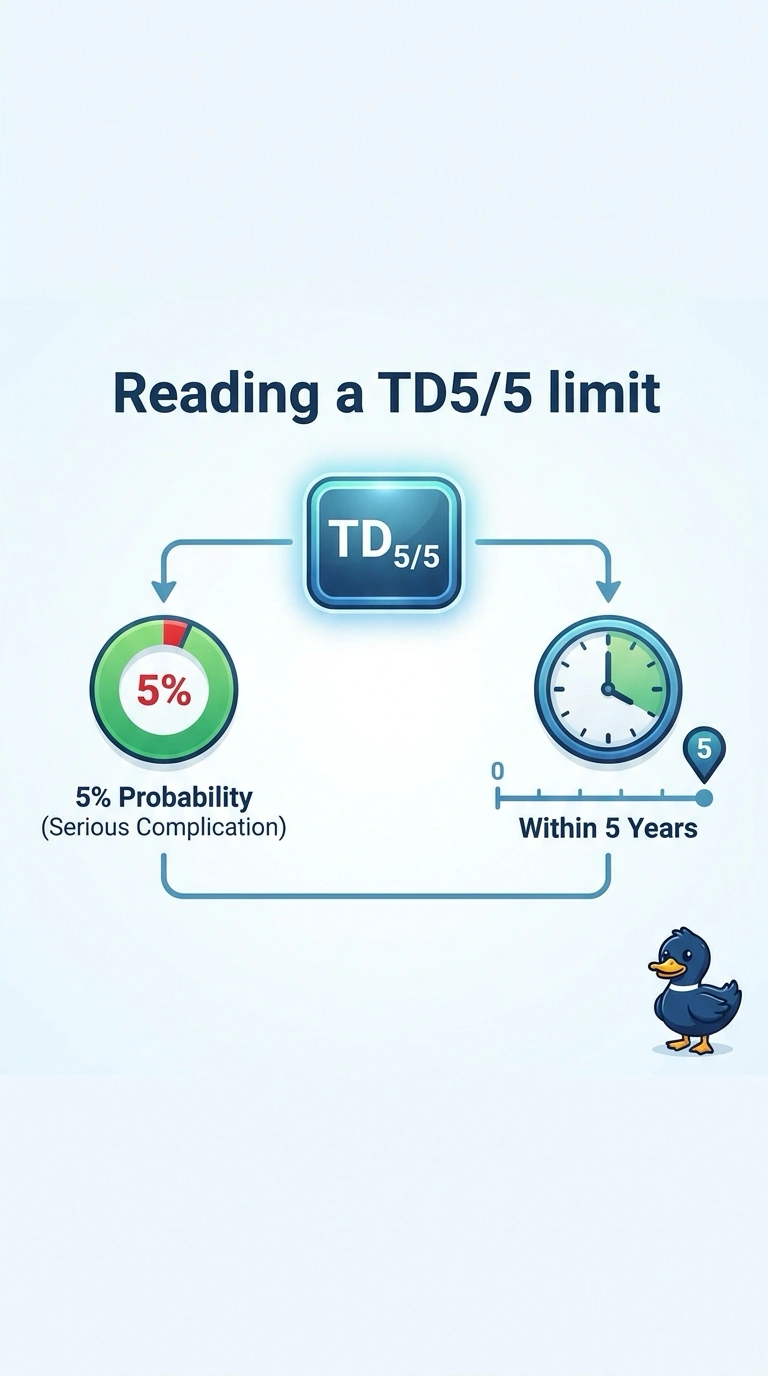
The two numbers work like a label: TD5/5 is the dose linked to a 5% chance of a specified serious complication within five years. It doesn’t measure tumor control or guarantee you’ll avoid complications for life.
Full Explanation
TD5/5 is a historical tolerance-dose notation for a dose associated with a 5% probability of a specified complication within five years. The estimate depends on the tissue, irradiated volume, fractionation, and other conditions used to derive it, so it should not be treated as a universal clinical dose limit. It is distinct from tumor-control probability, which describes tumor response rather than normal-tissue complications. The 95% distractor incorrectly extends the five-year period to a lifetime, and the 50% distractor changes the stated complication probability. In clinical planning, use current, applicable dose constraints and the relevant clinical context rather than relying on a TD5/5 value alone.