
A 6 MV anterior field treats a pelvic target at 100 cm SSD with a wedge in place. The prescription is 200 cGy at a depth where the wedged beam's percent depth dose is 80.0%, the 15×15 cm open field has an output factor of 1.050, and the measured wedge factor is 0.700. The unit delivers 1.00 cGy per MU at reference conditions. Which monitor unit value delivers the prescription dose at that depth?
Select an answer to reveal the explanation.
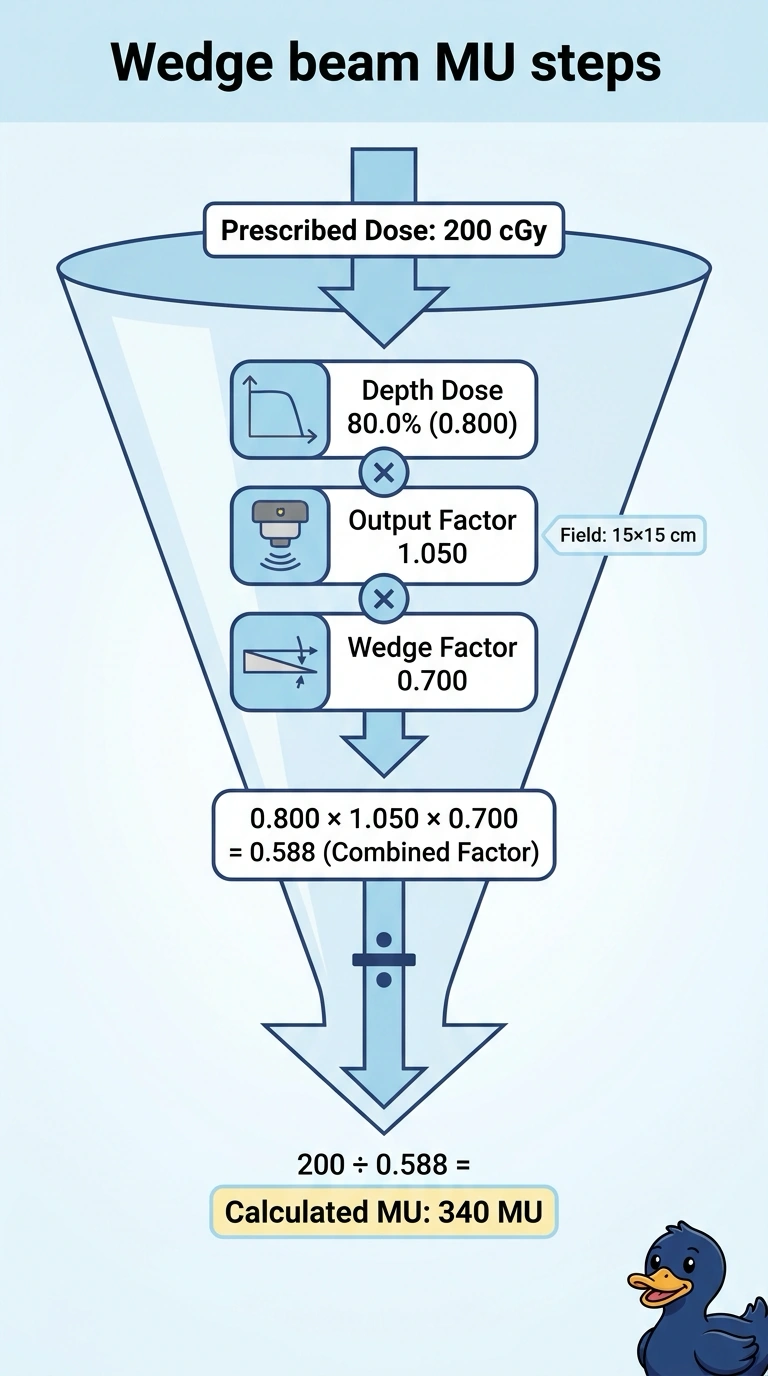
Short Explanation
You fold every output modifier into one divisor, because each one changes how much dose reaches the target per MU. Miss the wedge and you're really calculating an open field; skip the field size and you assume the reference square. The wedge factor is what turns an open-field number into the right one.
Full Explanation
For an SSD setup the monitor units come from dividing the prescription dose by every factor that scales machine output, so the divisor is the percent depth dose multiplied by the field-size output factor multiplied by the wedge factor. The depth dose accounts for attenuation and the loss of scatter between the surface and the target, the output factor accounts for the extra scatter produced by a 15 by 15 field compared with the 10 by 10 calibration field, and the wedge factor accounts for absorption in the wedge itself. Together these give 0.800 times 1.050 times 0.700, which is 0.588, so 200 cGy needs about 340 MU. An open-field calculation ignores absorption in the wedge and under-delivers the fraction, a reference-field calculation ignores the higher output of the larger field and over-estimates the units, and a calculation made at the depth of maximum dose skips the attenuation that happens before the beam reaches the target. A common exam trap is mixing an SSD depth dose calculation with an isocentric TMR calculation, so confirm the setup described before choosing a formula. As a practical check, multiply your MU by that same divisor and verify that the product returns the prescribed dose at the stated depth.