
A post-mastectomy patient is treated on a 6 MV linac with tangential fields at a fixed 100 cm SSD. Planning shows an even profile across the chest wall, but the buildup region leaves the dose at 3 mm depth well below the prescription, and the physician wants that superficial layer covered from the medial edge to the lateral margin. Which beam modifier should be added to bring the prescribed dose to the superficial chest wall layer?
Select an answer to reveal the explanation.
Short Explanation
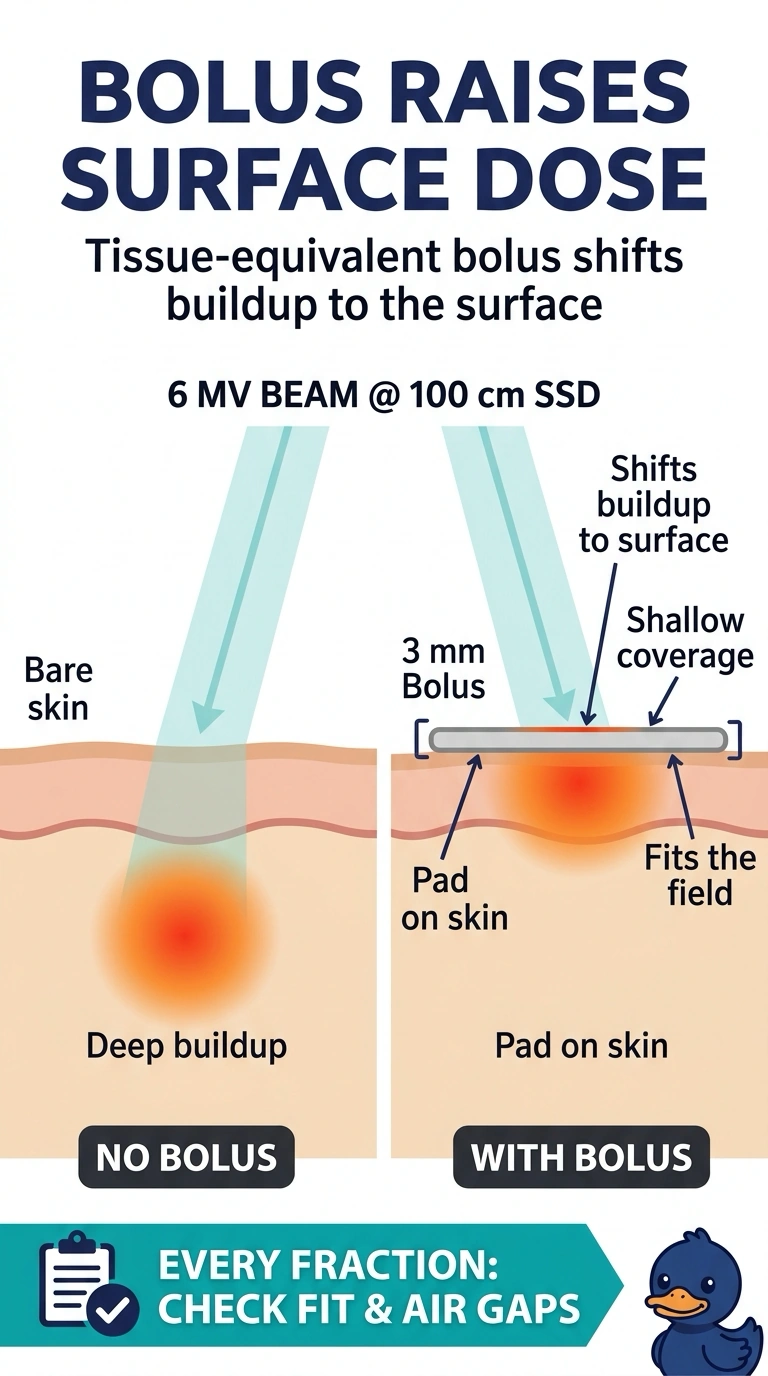
You’ll want to place bolus on the skin to shift the buildup region outward and raise the dose across the superficial chest wall. It’s like adding a tissue-like layer that helps the radiation reach closer to the surface; a wedge, block, or MLC won’t fix this shallow-dose gap.
Full Explanation
Photon beams build up dose gradually until they reach the depth of maximum dose, which is around 1.5 cm in tissue for a 6 MV beam. Tissue in the first millimeters is therefore on the buildup portion of the depth-dose curve and receives less dose than at the depth of maximum dose. Tissue-equivalent bolus placed on the skin shifts the buildup region toward the surface, raising entrance dose for a superficial target. A physical wedge redistributes intensity across the field to compensate for contour or thickness variation, but it is not the appropriate modifier for correcting an underdosed superficial layer. MLC leaves shape the lateral aperture but do not provide the needed buildup compensation. A custom block shields the area it covers and does not reliably raise superficial dose. Because bolus changes the dose distribution, it should be included in treatment planning and its fit and contact checked before treatment.