
A patient who had a testicular tumor removed is simulated for irradiation of the nodal drainage area, and the therapist checks that the field boundaries match the first-echelon nodes for this site. Which nodal region receives the primary lymphatic drainage from the testis?
Select an answer to reveal the explanation.
Short Explanation
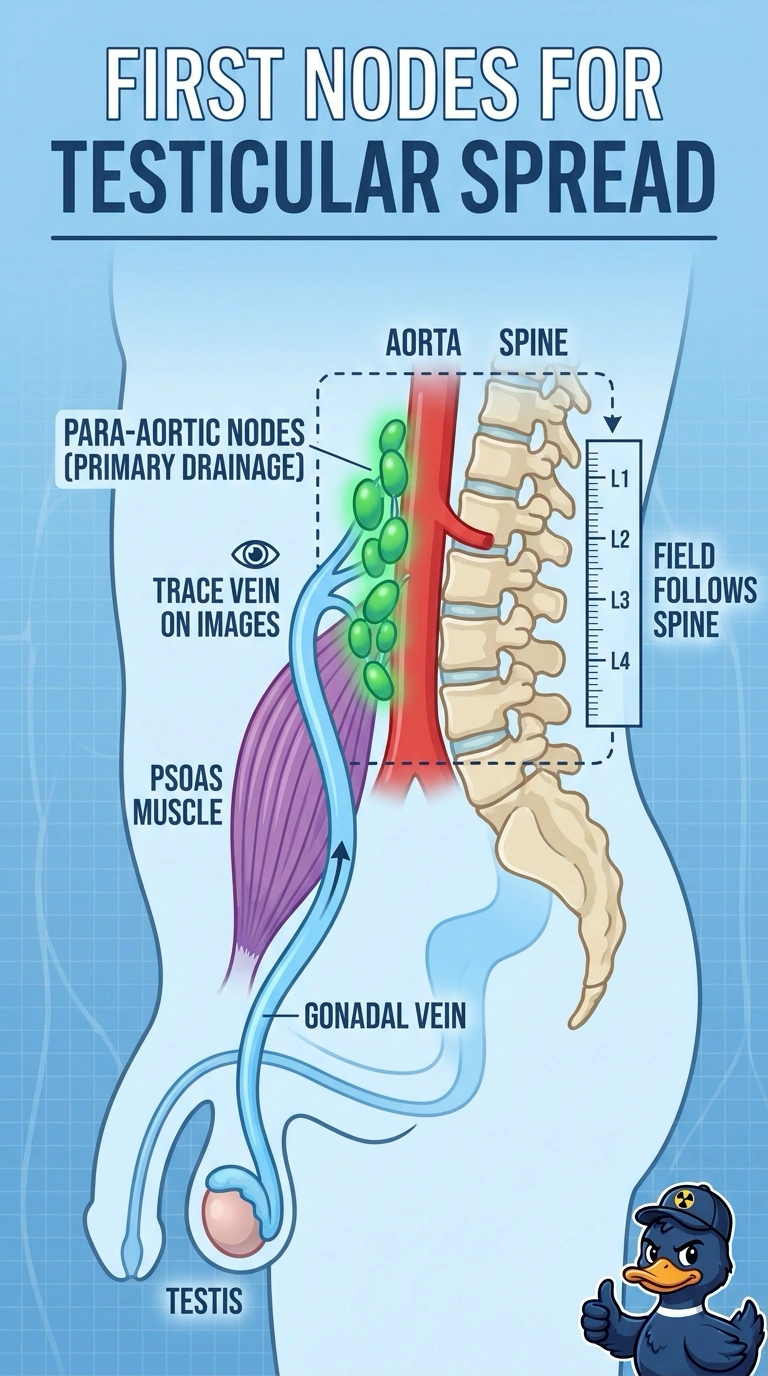
The testis drains along the gonadal vessels back to the para-aortic nodes, so that chain comes first for this site. It's like luggage riding the same rail as the testicular vein all the way up. The para-aortic nodes are your first-echelon target here.
Full Explanation
Testicular lymphatics travel upward with the gonadal vessels to join the drainage beside the great vessels, so the para-aortic chain receives the first-echelon spread from this organ. That is why the nodal target for a testicular tumor sits high in the abdomen beside the spine rather than in the pelvis, and why field borders follow vertebral levels along the aorta. The iliac route describes drainage from structures that empty into the pelvic venous and lymphatic plexus, such as the ductus deferens and epididymis, so it fails the requirement because it does not represent the testicular chain. The inguinal route belongs to the scrotal skin and superficial tissues, which drain externally, so it applies to scrotal involvement rather than to the testis itself. The obturator and common iliac pathway serves the pelvic basin containing the bladder, prostate, and reproductive organs, so it also misses the testicular drainage. The exam caveat is that nodal levels are described by vertebral landmarks rather than fixed station counts, so focus on the region. A practical check is to trace the gonadal vein on the simulation images, because the target follows that vessel.