
During a new-patient evaluation, a person who has smoked for decades but feels completely well asks what a screening test is for, and mentions a parent who had a different cancer. The clinic tailors prevention advice to each person's history. Which explanation of cancer risk factors and screening is accurate?
Select an answer to reveal the explanation.
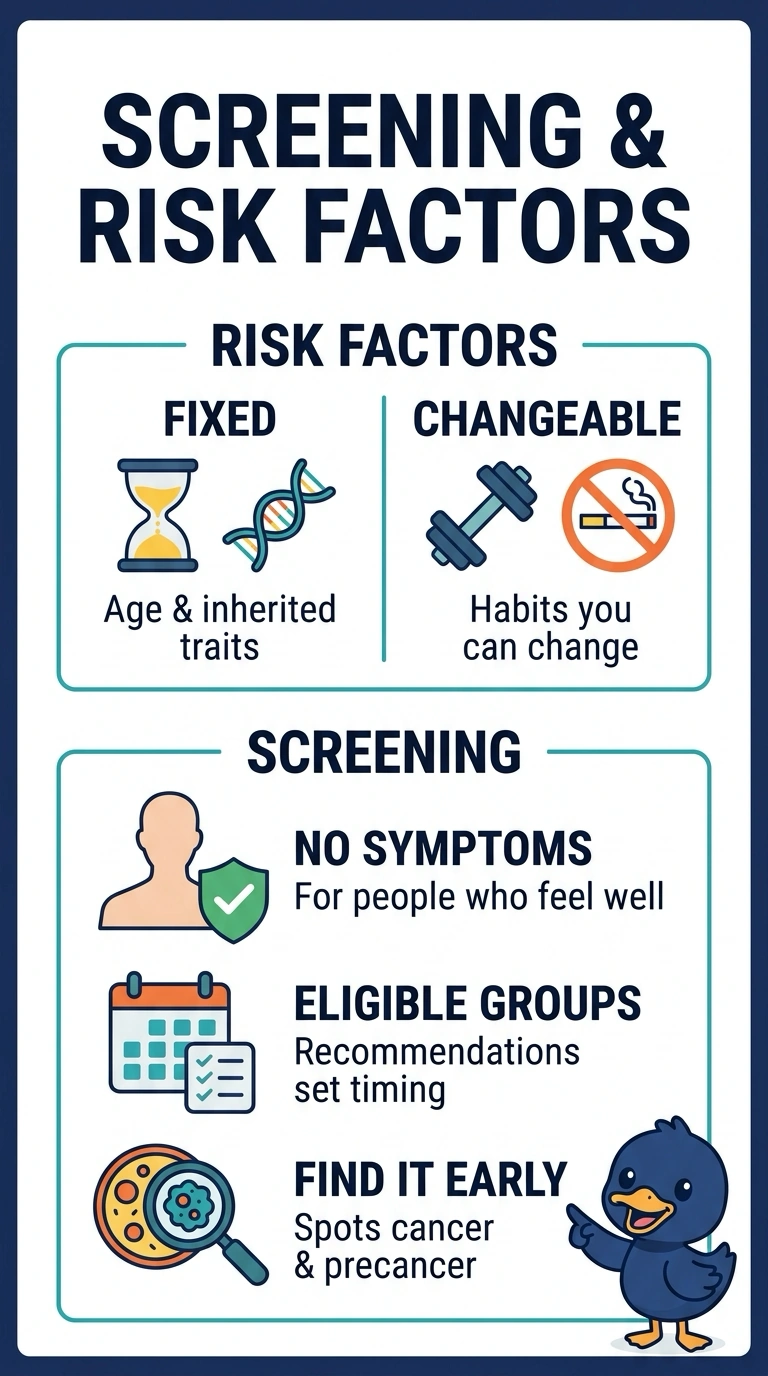
Short Explanation
Your cancer risk can come from factors you can change and fixed factors, like different cards in your hand. If you feel well, screening can look for cancer or precancerous changes when you meet the recommendations, which may depend on your age and history.
Full Explanation
Screening looks for cancer or precancerous changes in people who have no symptoms and meet recommendations for a particular screening test. Recommendations may depend on factors such as age, tobacco exposure, and family history, but not every risk factor changes screening eligibility or timing. Risk factors include things a person can influence, such as tobacco use, and things a person cannot influence, such as age or inherited traits; neither guarantees that cancer will develop. Screening is not applied uniformly to every adult, and follow-up after treatment for a known cancer is surveillance rather than screening. A test prompted by a sign or symptom is diagnostic evaluation, not screening. Specific test types, starting ages, and intervals vary by screening recommendation and can change over time.