
A plan-review worksheet lists three courses: course A gives electron treatments across the whole skin surface, course B gives fractionated irradiation to the whole body, including the lungs, liver and marrow, as transplant conditioning, and course C places an internal source in a surgical cavity. Which course should be labeled total body irradiation?
Select an answer to reveal the explanation.
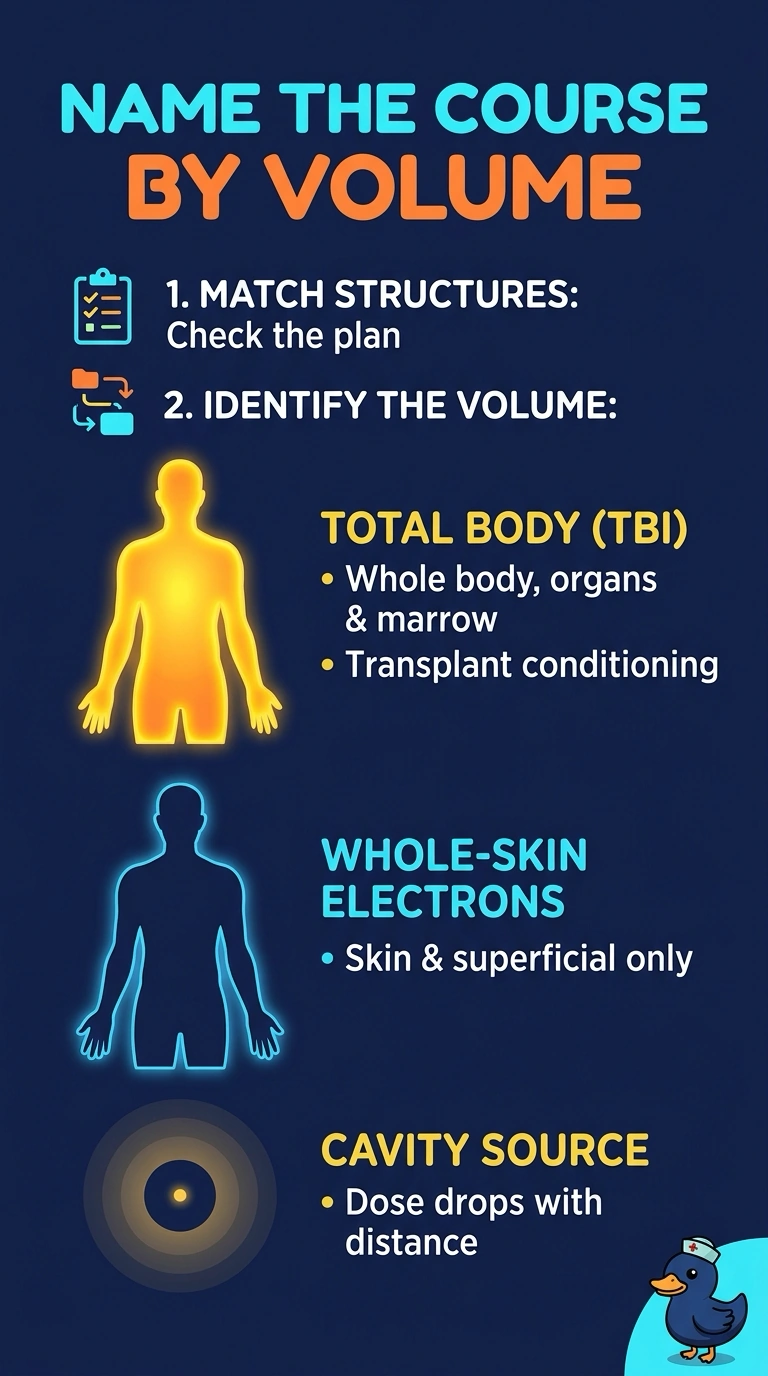
Short Explanation
You name this one by the volume treated, not by how big the field looks on the screen. The conditioning course irradiates the whole body, including internal organs and marrow. Whole-skin electron treatment is designed to treat the skin and superficial tissues, so it's a different technique.
Full Explanation
Classifying a course depends on the volume treated and on treatment intent. Total body irradiation (TBI) delivers dose throughout the body and is commonly used as part of transplant conditioning. The skin course is a surface treatment: electron beams deposit most of their dose superficially, although dose also reaches underlying tissues. The cavity course is a localized treatment, where a source placed in the surgical site delivers dose to nearby tissues, with dose decreasing with distance. Labeling the whole-skin course as TBI confuses treatment of the body surface with irradiation throughout the body. Labeling the cavity course as TBI confuses a localized treatment with whole-body treatment. A practical check at plan review is to match each course to the structures and volume specified in the prescription before the worksheet is signed.