
Two adjacent fields abut along a junction marked on the upper chest of a patient who is set up for treatment. The plan uses half-beam blocking so each field edge sits at its own central axis, and the therapist must confirm the match before treating. Which measurement verifies that the two field edges abut without overlap or gap?
Select an answer to reveal the explanation.
Short Explanation
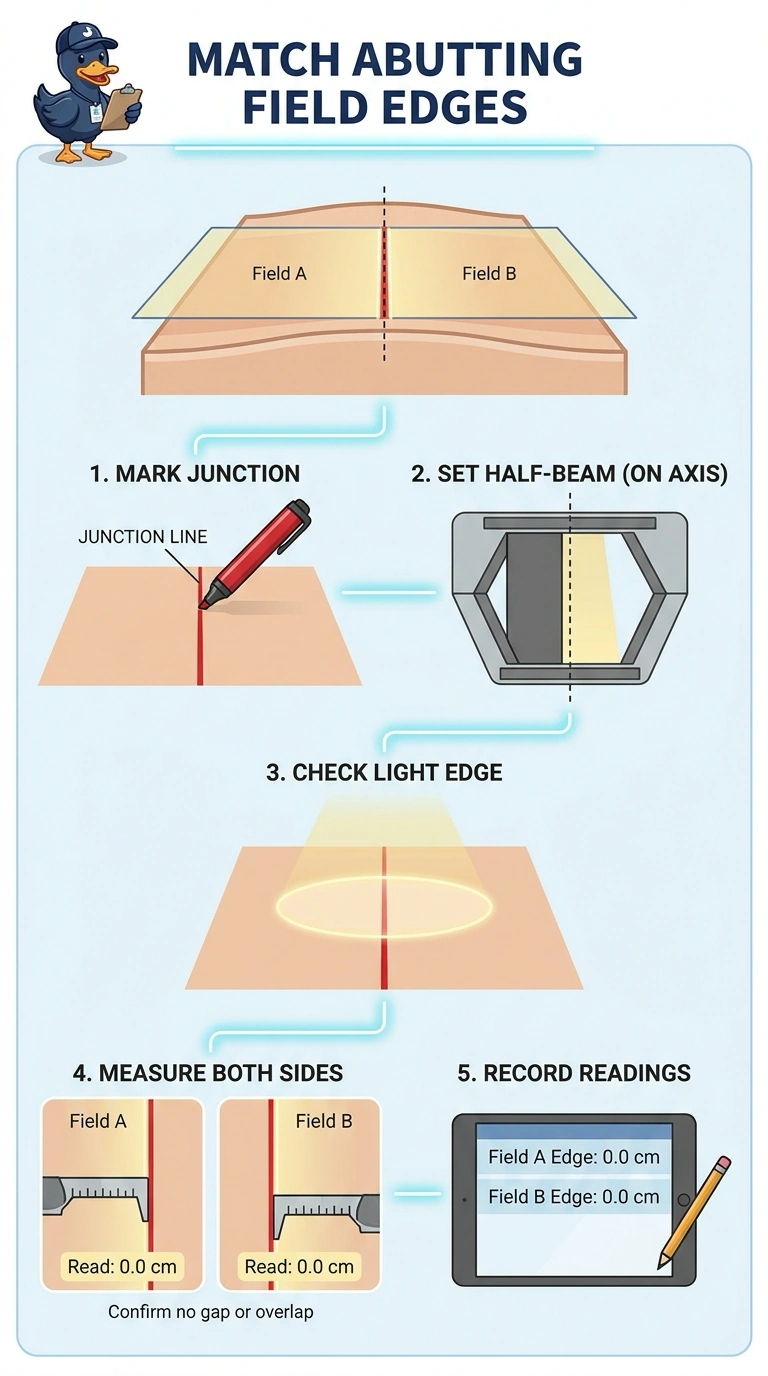
With half-beam blocking, you can verify the match by checking where each light-field edge meets the junction mark on the skin. Look right at the seam: the junction line shows whether the edges abut without a gap or overlap.
Full Explanation
With half-beam blocking, one side of each field is shaped so its edge lies on the central axis. This removes beam divergence along the junction and makes the two field edges coplanar. To verify that they abut without a gap or overlap, measure each light-field edge against the junction line marked on the skin; this directly shows where the edges meet at the patient’s surface. Matching each field’s source-to-surface distance to the planned value confirms setup distance at the entrance point, but does not establish the lateral position of either edge. Confirming symmetric jaw widths on the console is also insufficient: half-beam blocking deliberately places a jaw at the central axis, so symmetric-width readings do not demonstrate that the junction is aligned. Checking that the junction skin-to-axis depth matches the planned value assesses depth, but correct depth alone does not guarantee that the field edges meet correctly. An exam caveat is that this is a geometric setup check at the skin, not a verification of the delivered-dose distribution. For a practical check, place a ruler across the junction mark and compare each light-field edge with that mark, recording the readings before treatment.