
During a CT simulation of a pelvis plan, the target is contoured on every axial slice, but the crosshair on the coronal reconstruction sits close to the superior edge of the volume. Which check confirms the isocenter before skin marks are made?
Select an answer to reveal the explanation.
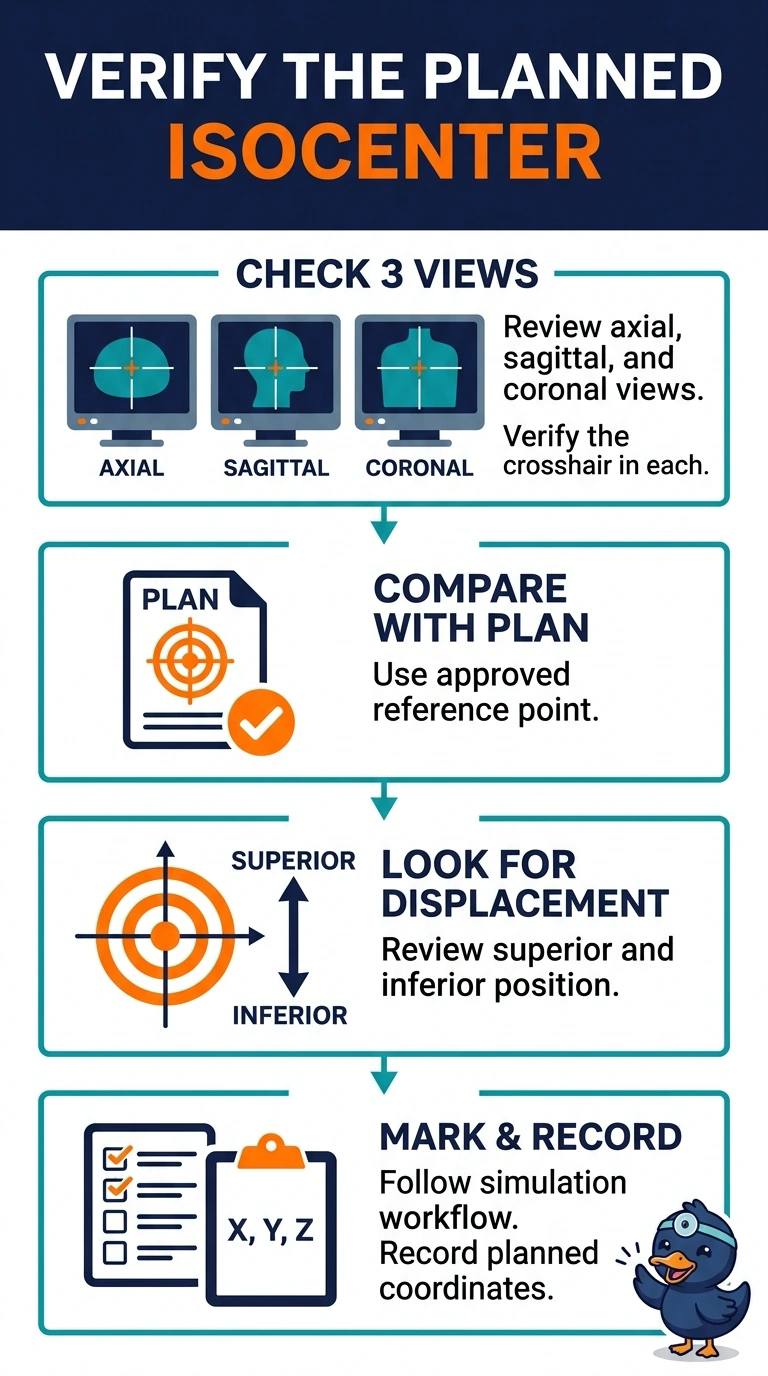
Short Explanation
Before you make skin marks, check the crosshair on the axial, sagittal, and coronal views and compare it with the planned isocenter and approved reference point. This gives you a view from all three directions; don’t assume the isocenter is the target’s geometric center.
Full Explanation
The correct check reviews the crosshair on the axial, sagittal and coronal reconstructions and verifies its position against both the planned isocenter and the approved reference point. This matters because a crosshair near the superior edge on the coronal view may indicate a positioning or coordinate mismatch that is not apparent from axial contouring images alone. Reviewing axial and sagittal views while checking the planned isocenter and approved reference point omits the coronal view, so it could miss the superior-inferior relationship highlighted in the scenario. Reviewing all three views and comparing the crosshair with the planned isocenter and a reproducible skin landmark does not verify it against the approved reference point; the landmark can help with setup but does not replace that reference. Checking whether the crosshair is centered within the contoured target is also insufficient, because the treatment isocenter is planned and need not coincide with the target’s geometric center. Exam caveat: a displayed crosshair shows a coordinate intersection, not proof that the planned isocenter or room setup is correct. Practical check: before making skin marks, confirm the planned isocenter coordinates and approved reference point in the planning record, then verify their correspondence on all three views.