
A plan delivers the prescription dose to the target while a large volume of late-responding soft tissue sits inside the high-dose region. The oncologist wants to lower the risk of a late normal-tissue reaction, but the target dose and the dose per fraction must both stay the same. Which change to the plan would most reduce that late-reaction risk?
Select an answer to reveal the explanation.
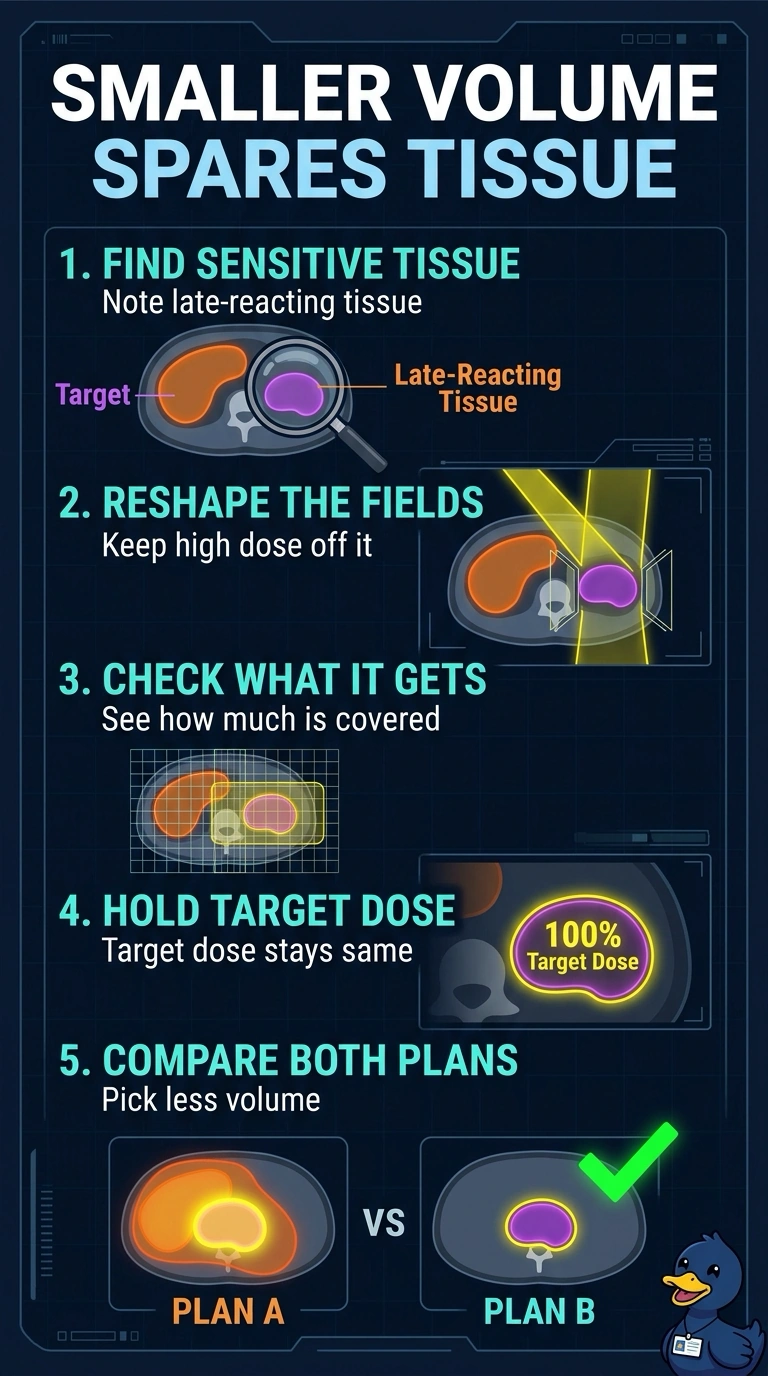
Short Explanation
You can lower the risk by reshaping the fields so less late-responding tissue sits in the high-dose region, while keeping the target dose and dose per fraction unchanged. It’s like narrowing a spotlight to keep the same brightness on the target but spill less light onto nearby tissue.
Full Explanation
Reshaping the fields is the best choice because it can reduce the amount of late-responding soft tissue receiving high dose while preserving both the target dose and dose per fraction. This directly addresses the stated risk factor—the volume of normal tissue in the high-dose region—without changing the prescription or fractionation. Proton therapy can reduce dose beyond the target and is a useful normal-tissue-sparing approach, but the scenario specifically places a large volume of soft tissue inside the high-dose region; changing modality does not necessarily spare tissue encompassed by that region, so it does not directly resolve the stated problem. Amifostine is a radioprotective drug used in selected settings, but it leaves the treatment plan and high-dose volume unchanged; it therefore does not make the requested plan change or address the stated dose distribution. Hyperfractionation with more, smaller fractions can reduce late effects for a given total dose, but it changes the dose per fraction, which the oncologist requires to remain fixed. Exam caveat: a strategy that lowers normal-tissue toxicity in general is not automatically suitable when the question imposes dose and fractionation constraints. Practical check: compare dose-volume histograms for relevant late-responding tissues before and after replanning, confirming target coverage and the prescribed dose per fraction are maintained.