
The bladder has been outlined on every axial slice of a pelvis CT taken at a fixed slice interval, with each outline's area stored on the workstation. The reported volume must account for every outline that was drawn. Which calculation gives the contoured bladder volume?
Select an answer to reveal the explanation.
Short Explanation
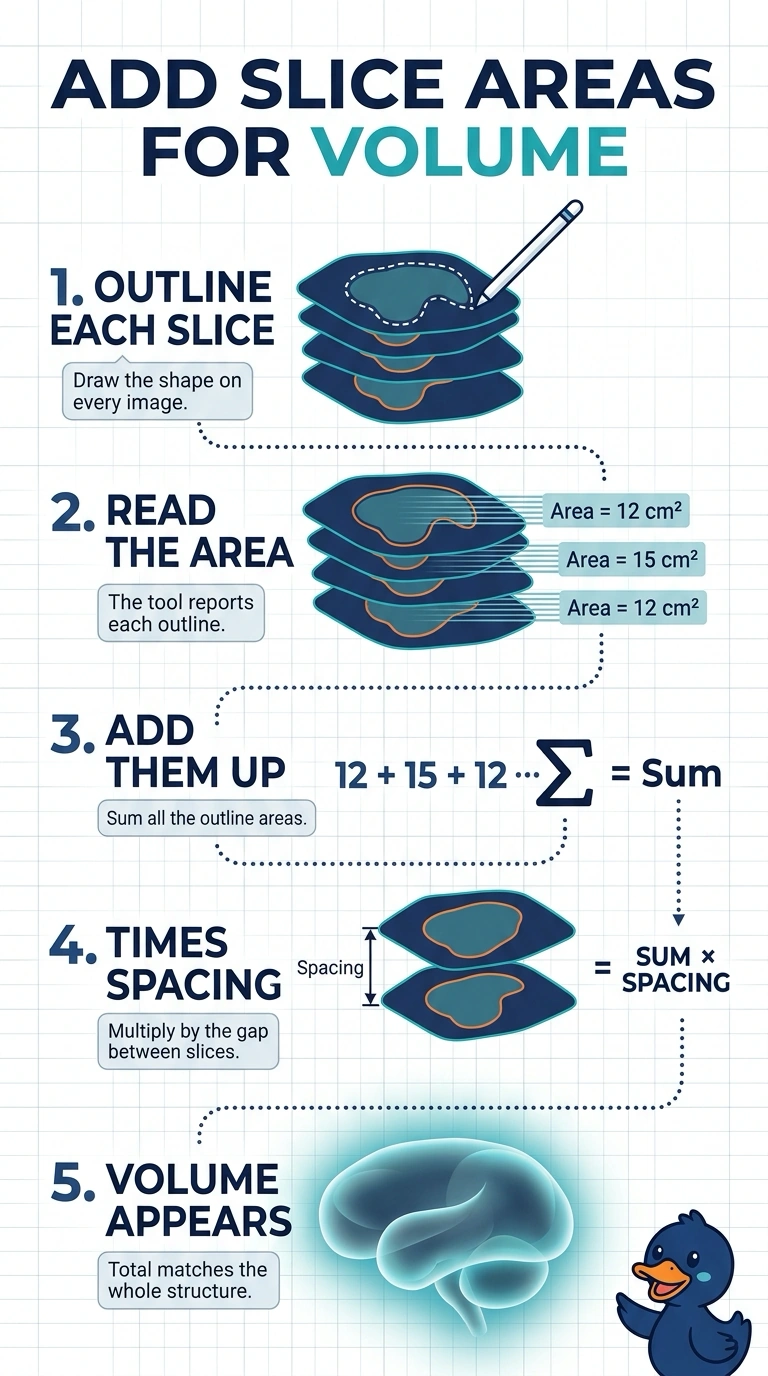
Stacking the slice areas and multiplying by the slice spacing turns a stack of drawings into a real volume. It's like counting the layers of a cake: each layer's size times its thickness gives you the whole thing.
Full Explanation
The correct calculation is the sum of the area on each axial slice multiplied by the fixed slice spacing. Each outline represents a slice’s contribution to the contoured volume, so this rectangular-slab calculation includes every stored area with the appropriate thickness. The trapezoidal rule is a standard way to integrate sampled cross-sectional areas, and it uses all the outlines, but integrating only between the first and last slice centers omits the half-slice extent at each end represented by the first and last contours. Simpson’s rule likewise uses all sampled areas to estimate an integral between the outermost slice centers; it therefore has the same boundary problem here, even when its sampling and smoothness assumptions are appropriate. Averaging all slice areas and multiplying by the center-to-center distance is also a familiar mean-area approximation, but that distance spans one fewer slice interval than the number of contoured slices, leaving out the end-slice extent. Exam caveat: trapezoidal or Simpson integration can be appropriate when the intended volume is explicitly defined only between contour planes, rather than as the sum of full slice slabs. Practical check: if there are n outlines at spacing d, the slab-sum calculation uses n area contributions, each weighted by d—not a total length of only (n−1)d.