
A patient whose first language differs from the one used by every staff member is about to begin a planning session while a teenage relative translates your explanation of the word 'isocenter.' You need certainty that the patient understands the term before the session starts. Which method best confirms the patient's own understanding of the explanation?
Select an answer to reveal the explanation.
Short Explanation
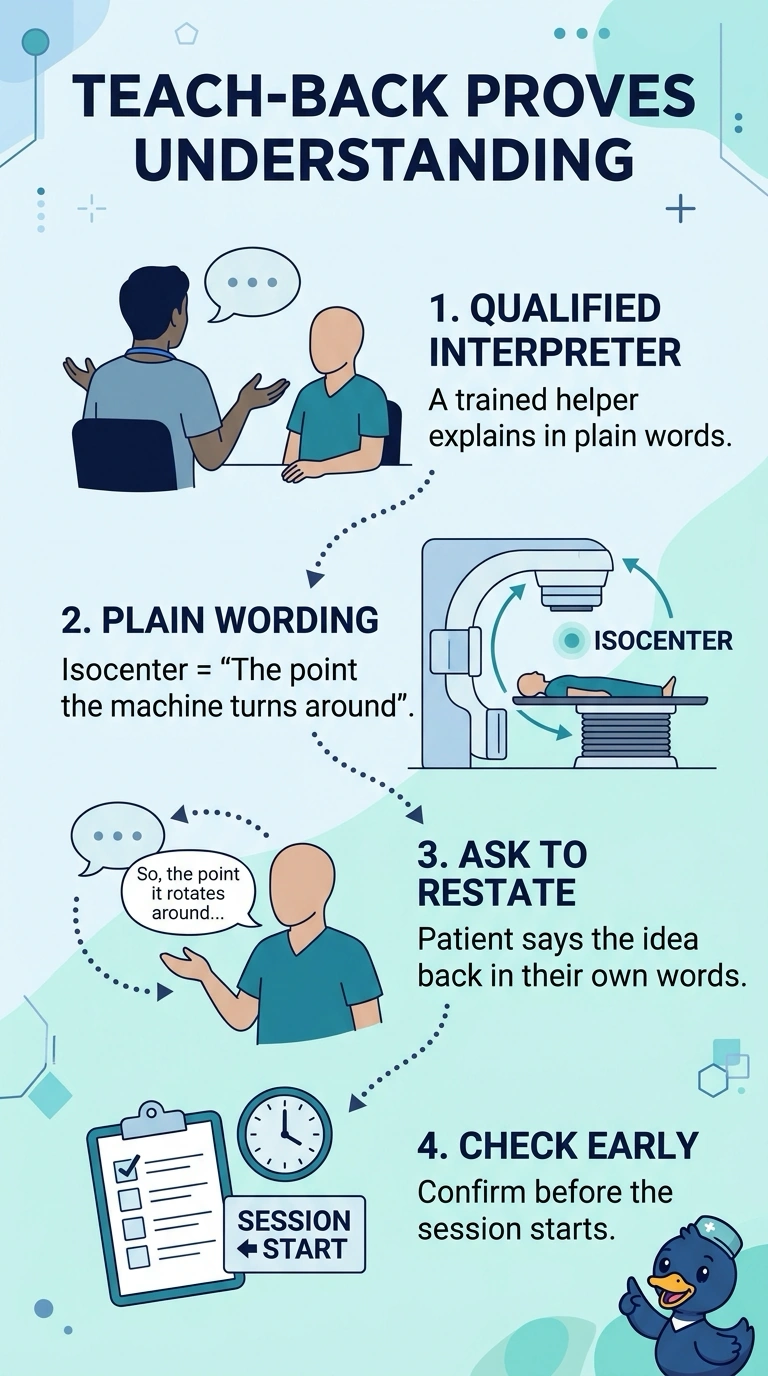
You need proof from a trained interpreter plus teach-back, because a nod or a signature only shows agreement. Teach-back just means asking them to say it back — if they can restate it, they've got it.
Full Explanation
The best method combines a qualified medical interpreter with an explanation in everyday language and teach-back: the patient, rather than the interpreter or a relative, explains the concept in their own words. This gives the team a direct check of the patient’s understanding before planning begins and allows clarification if needed. Asking whether the explanation is clear is respectful and can reveal concerns, but a patient may agree without being able to explain the term; it does not confirm understanding as directly as teach-back. Asking for teach-back after giving the technical definition uses a strong check, but the explanation itself may remain difficult to understand because it is not in everyday words. A professionally translated plain-language handout followed by teach-back also checks understanding, but it does not provide the qualified medical interpreter needed to communicate and clarify the explanation interactively in this scenario. Exam caveat: teach-back is a check on how well the information was explained, not a test of the patient; invite the patient to describe the idea without implying blame. As a practical check, ask the patient to explain what the isocenter means for their planning session, then correct any misunderstanding and ask them to describe it again.