
During fraction 14 of a lung boost course, the record-and-verify screen still shows the original 200 cGy dose and the old isocenter even though yesterday's revised plan was approved at 180 cGy with a shifted isocenter, and on-treatment imaging matches the new target. Which step confirms the plan version, isocenter, and dose before the beam is released?
Select an answer to reveal the explanation.
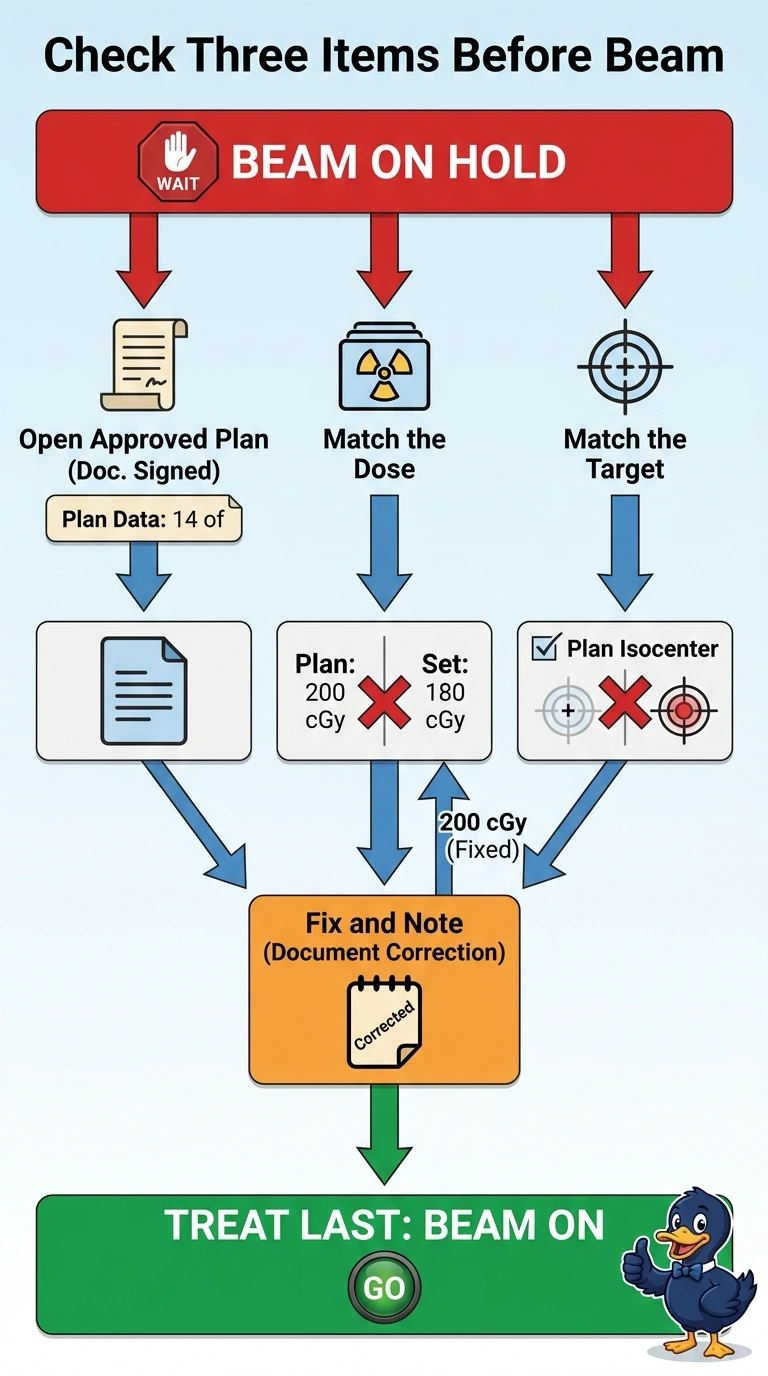
Short Explanation
You’re right to keep the beam on hold until the record-and-verify data match the approved plan. Reconcile the plan version, shifted isocenter, and 180 cGy dose, then document the correction before treatment.
Full Explanation
Keep the beam on hold until the record-and-verify data match the approved revised plan: confirm the plan version, shifted isocenter, and 180 cGy dose, then document the correction before treatment. This prevents delivery using stale console data and creates an auditable record of the resolution. Releasing after confirming all three details but documenting the reconciliation afterward is not sufficient, because documentation must be complete before beam release. Checking the plan version and dose while relying on matching on-treatment imaging does not confirm that the console isocenter matches the approved plan; imaging supports localization but does not verify the displayed isocenter. Having a second therapist confirm the plan version and shifted isocenter still leaves the stale dose field unreconciled, and the approved prescription does not establish that the console is configured for the correct dose. Exam caveat: image guidance can corroborate patient positioning or target alignment, but it does not replace verification of treatment-console parameters. Practical check: compare the active plan identifier, isocenter coordinates, and dose at the console with the approved plan, resolve any mismatch, and document the correction before releasing the beam.