
A clinic stores a sealed radionuclide unit beside a linac for cross-checking calibration. The radionuclide keeps emitting during a power outage, while the linac makes no beam; both are checked against the same absorbed-dose standard. Which statement best distinguishes radionuclide emission from machine-produced radiation?
Select an answer to reveal the explanation.
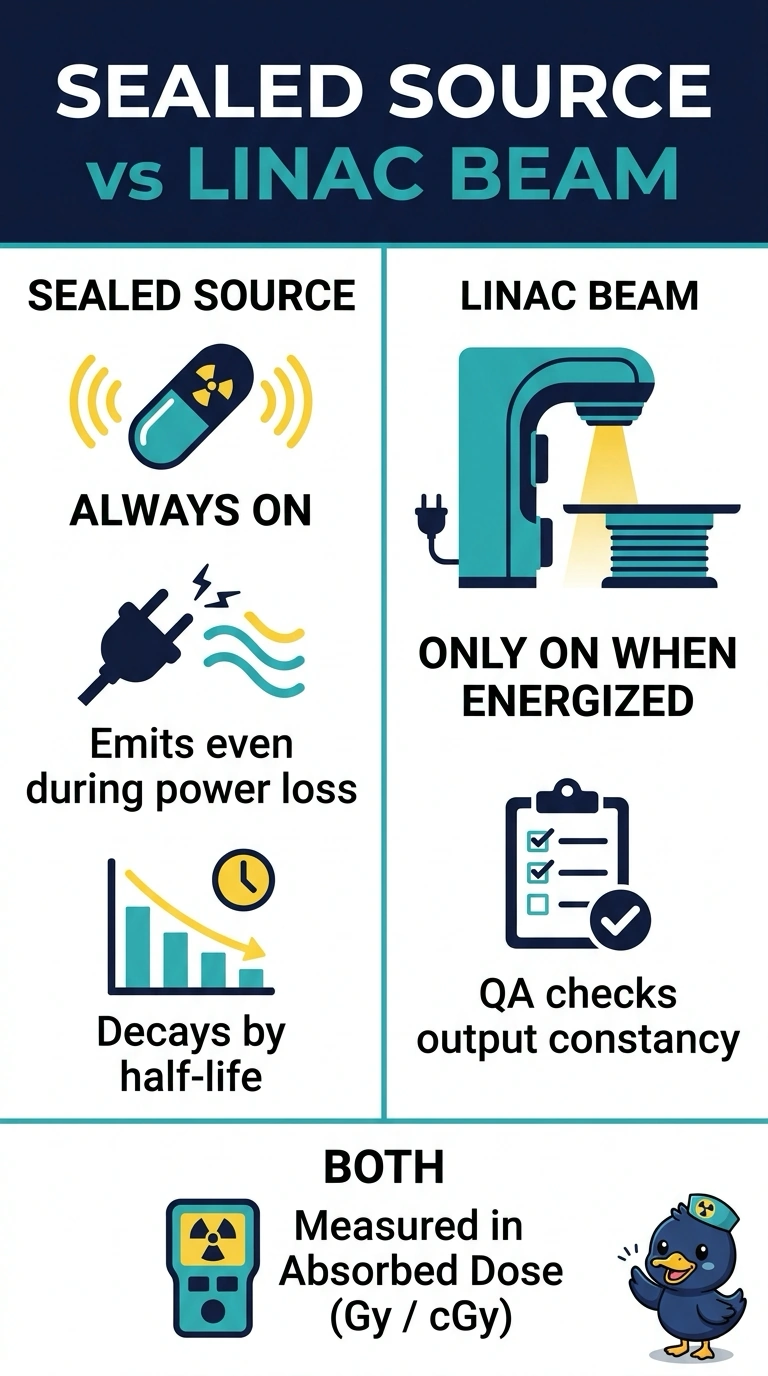
Short Explanation
You can think of a sealed source like a clock that keeps ticking: it emits radiation as its activity decreases, even when the power’s out. Your linac is different—it produces a beam only when it’s energized.
Full Explanation
The correct statement identifies the key physical distinction: radioactive decay continues independently of electrical power, whereas a linac produces its treatment beam only when powered and operated. A shared absorbed-dose standard allows the units to be compared dosimetrically, but it does not make their radiation-production mechanisms alike. Shielding a sealed source is standard radiation protection practice, but it attenuates radiation outside the shield; it does not stop the radionuclide from emitting. Characterizing a source by activity and photon energy and specifying linac output by dose per monitor unit are both routine, useful descriptions, but they do not establish what happens during an outage, so they do not answer the distinguishing question. Calibrated chambers and linac monitor chambers are also standard measurement tools; however, a linac's monitor chamber cannot provide beam output when the linac has no power, so the claim that both remain available during an outage is false. Exam caveat: “cannot be switched off” refers to nuclear decay, not to whether a shutter or shield can reduce the radiation reaching a location. Practical check: confirm the source's current activity and shielding status, and verify that the linac is de-energized and producing no beam before interpreting outage measurements.