
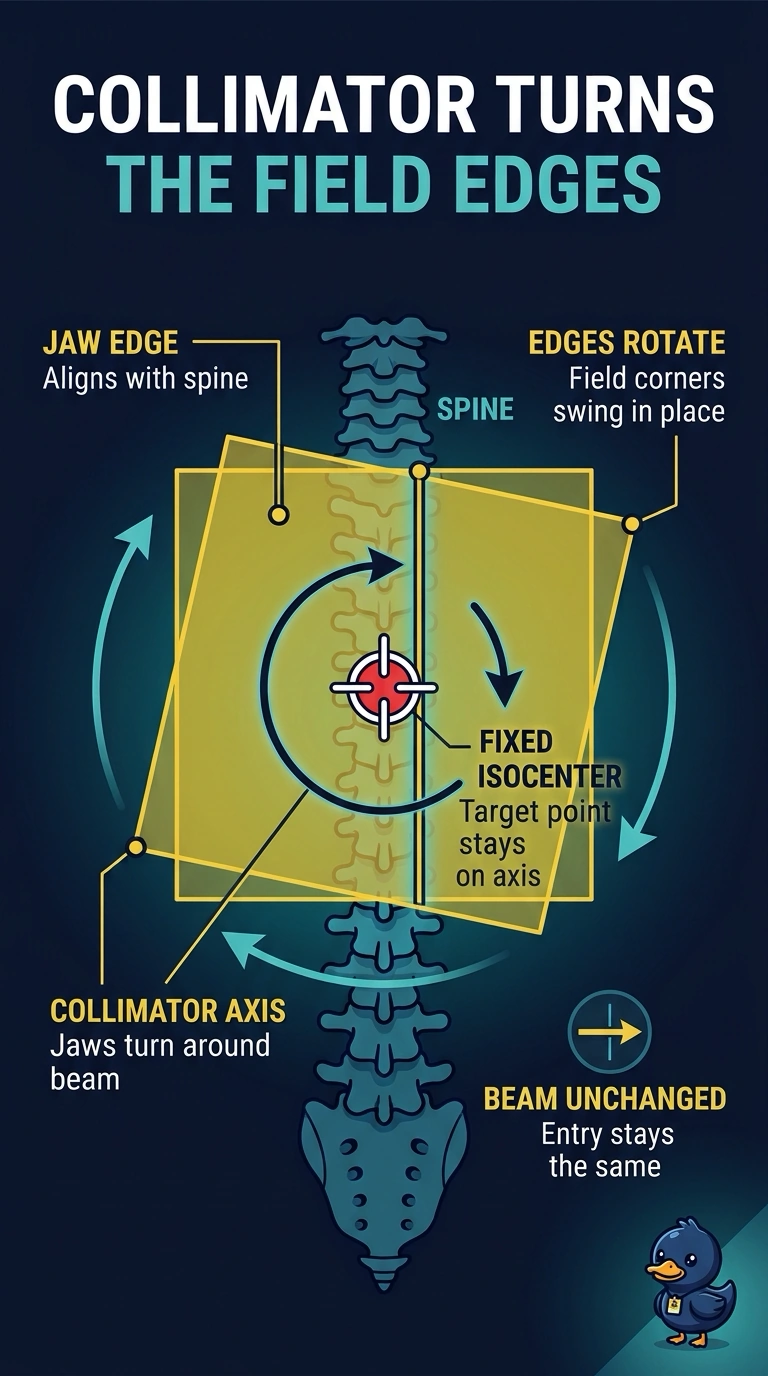
During setup for a supine spine field, the image shows the jaw edges running about ten degrees off the patient's spine, while the isocenter sits on the target and the beam must enter from the planned direction. Which single control change lines the field edge up with the spine?
Select an answer to reveal the explanation.
Short Explanation
Only the jaws can spin the field while the beam stays put, so collimator rotation is your move. You're basically turning a stencil in place with the collimator — the corners swing and your hand doesn't.
Full Explanation
The collimator turns the jaw assembly about the beam's own axis, so the projected field corners swing to a new orientation while the beam's entrance direction and the isocenter point remain fixed, which is exactly what an obliquely running spine needs. Rotating the gantry to a matching oblique angle fails the beam-entry requirement, because it changes where the radiation comes from in the patient's anatomy and repositions the beam relative to the target and nearby critical structures. Sliding the couch lengthwise fails the alignment requirement, because a longitudinal shift only translates the field, leaving the jaw edge at its original angle while moving the isocenter off the target. Turning the couch top fails the geometry requirement, because the patient rotates under a fixed beam, changing the beam-to-patient relationship the plan was built on and hurting daily reproducibility. The exam caveat is that gantry rotation changes entry direction, couch shifts change position, and collimator rotation changes field orientation. As a practical check, confirm on the portal image that the jaw edge and the spine run parallel and that the isocenter marker has not shifted.