
A patient with a documented MRSA lesion on the forearm finishes a fraction in a shared treatment room. In ten minutes that same couch, arm board and accessories will hold the next patient, who will be positioned by hand. Which infection control step breaks the chain of transmission before that setup?
Select an answer to reveal the explanation.
Short Explanation
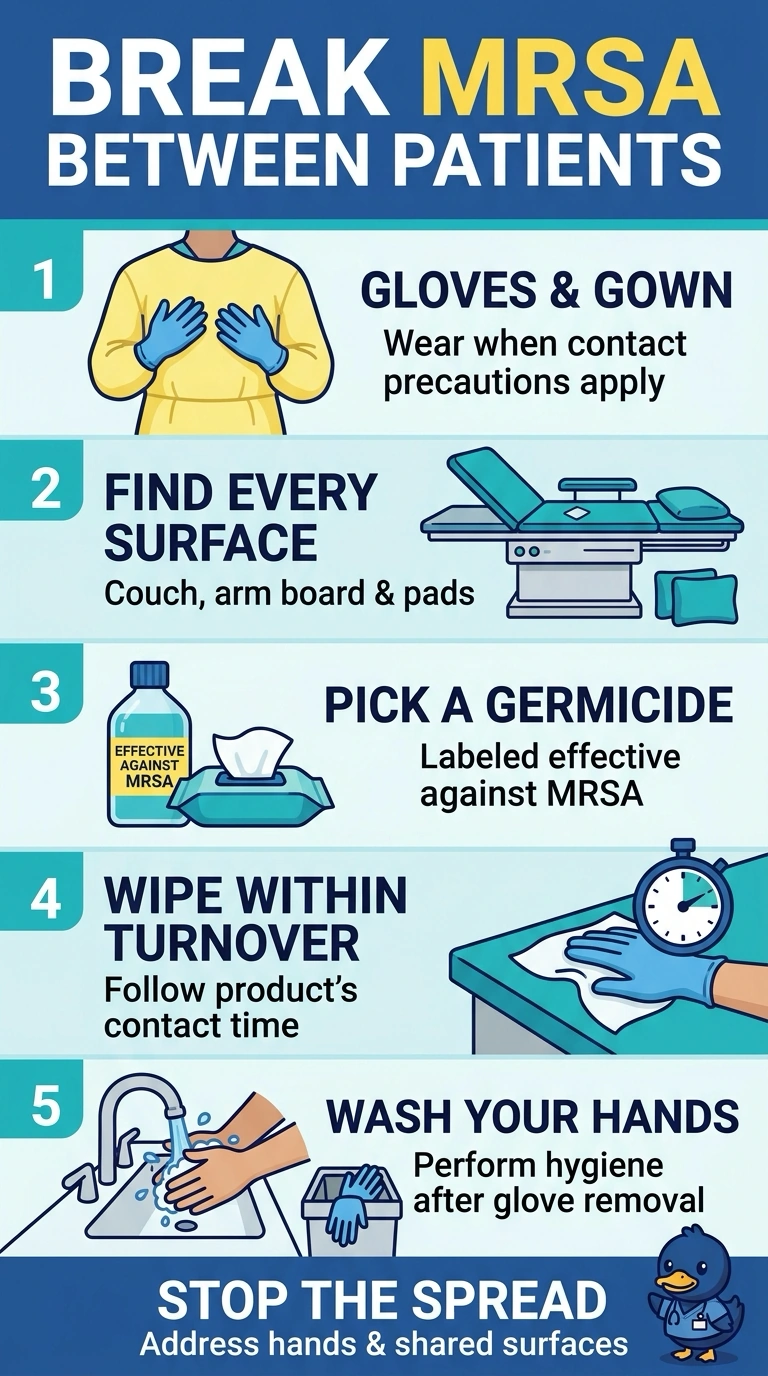
You should wear gloves and a gown, then disinfect the couch, arm board, and accessories with a product labeled effective against MRSA—that helps interrupt contact transmission. Finish with hand hygiene before you touch the next patient.
Full Explanation
The correct step interrupts contact transmission before the next setup: gloves and a gown provide barrier protection while you handle the patient or contaminated surroundings, and hand hygiene reduces transfer by your hands. Crucially, you disinfect the couch, arm board, and accessories that may be touched during positioning with a product whose label supports use against MRSA, observing its required contact time. Using a routine hospital disinfectant without confirming that its label covers MRSA does not establish that it is appropriate; a familiar product or general cleaning claim is not a substitute for checking the organism-specific label. Wearing gloves without a gown leaves clothing unprotected from contact with the lesion or contaminated surfaces, even if cleaning and hand hygiene are performed. Disinfecting the couch and arm board but not the accessories leaves items used or touched during positioning untreated; they can carry contamination just as the other surfaces can. Exam caveat: follow the facility’s transmission-based precautions and product instructions, since required PPE and approved products may vary with the exposure and policy. Practical check: before the next patient enters, verify that every listed surface and accessory was treated with an appropriate product for its full labeled wet-contact time, then perform hand hygiene.