
During monthly output constancy QA, the team irradiates a water-equivalent phantom at the machine's reference geometry and compares the reading with the established baseline for that machine. The result must appear in the same session, be an absolute dose in cGy, and come from a detector suited to the beam energy. Which detector should the therapist use for the output measurement?
Select an answer to reveal the explanation.
Short Explanation
You need an absolute dose you can read right away, so a calibrated ion chamber is the tool for the job. It's like using a properly calibrated scale instead of one that drifts each time you step on it.
Full Explanation
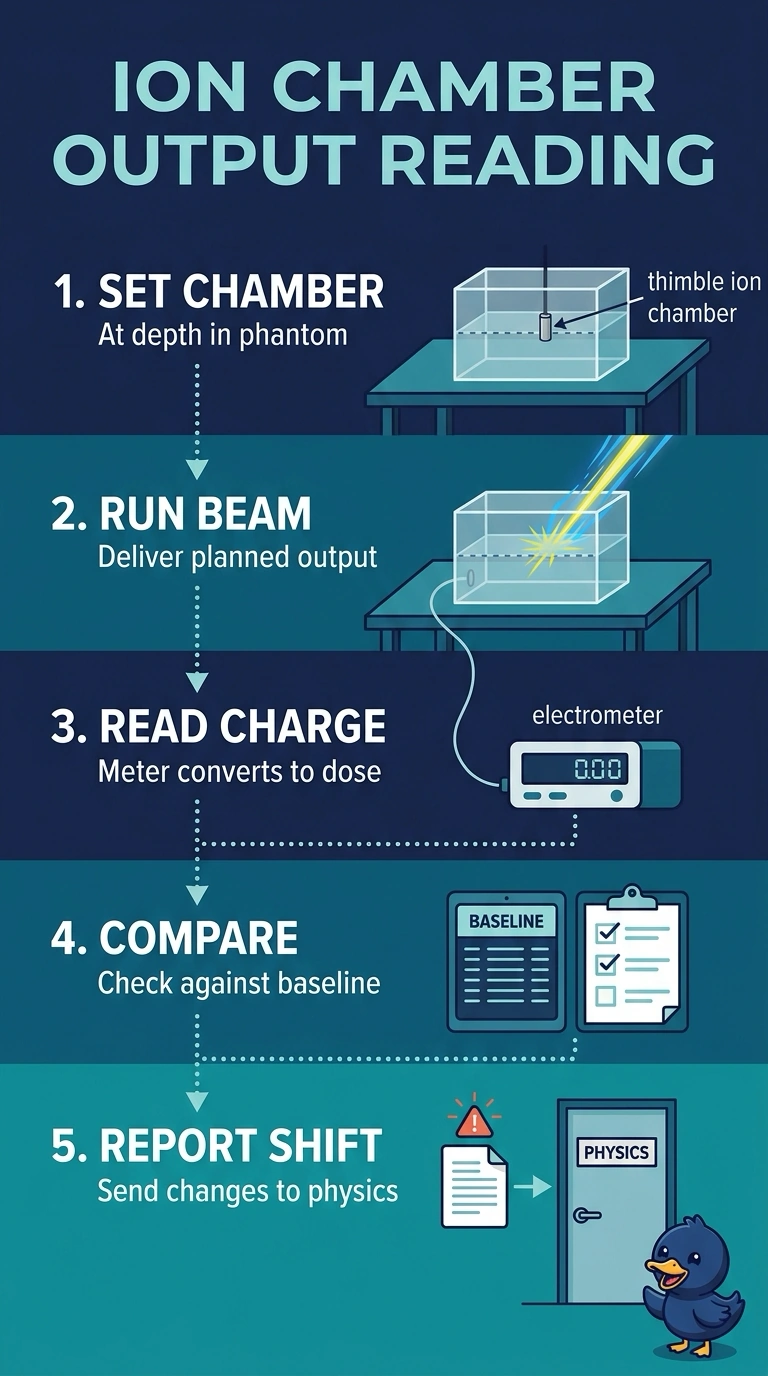
A calibrated thimble ionization chamber connected to an electrometer is the appropriate choice for a reference-geometry output measurement: it is suited to therapeutic beam dosimetry, provides a prompt reading, and can report an absolute dose in cGy for comparison with the machine baseline. Radiochromic film can be calibrated for absolute dose and positioned in a phantom, but it generally must be removed and scanned and its response analyzed; it therefore cannot provide the required result in the same session. A calibrated thimble chamber can give an immediate absolute reading, but placing it at the phantom surface instead of the specified reference depth changes the measurement geometry and does not establish output at the reference condition. A kilovoltage ion chamber can be calibrated and provide an immediate absolute reading in a phantom, but its energy response and construction are intended for diagnostic-range beams, not a megavoltage therapy beam, so it is not an appropriate detector for that beam. Exam caveat: “calibrated” alone does not make a detector suitable; calibration must apply to the detector, beam quality, and measurement geometry. Practical check: verify the chamber’s calibration certificate and beam-quality suitability, then confirm the reference depth, field, and setup before recording the cGy reading.