
During a teaching visit, a patient with limited English proficiency must learn positioning, skin care, and what erythema means before starting daily treatments. The patient's teenage child offers to translate. The therapist wants a reliable check that the instructions landed. Which communication approach best confirms the patient understands the medical terms and instructions?
Select an answer to reveal the explanation.
Short Explanation
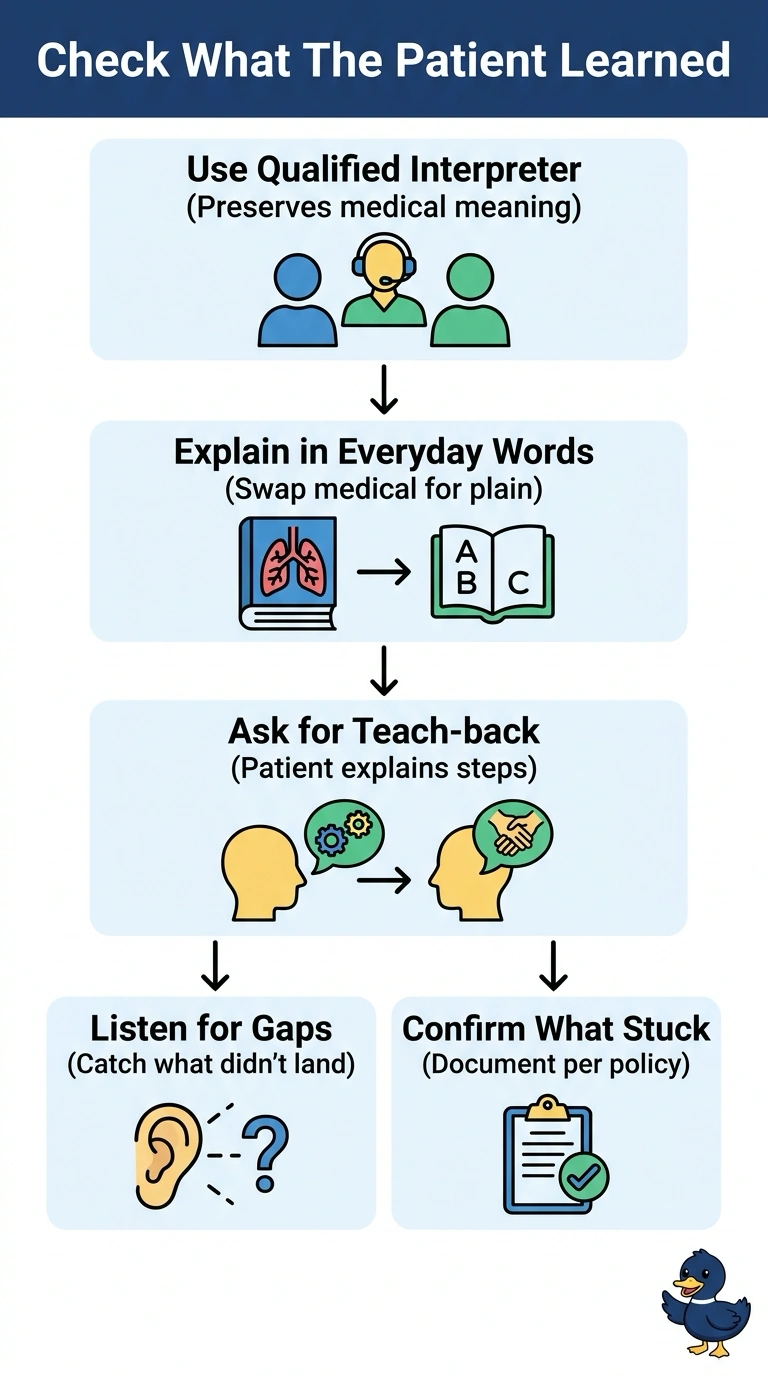
A trained interpreter helps preserve the medical meaning, and teach-back turns a polite nod into a check of understanding. You wouldn't hand someone a recipe in a language they barely read and call it cooked. The teach-back method helps show what actually stuck.
Full Explanation
Using a qualified interpreter helps preserve the meaning of each medical term, because a relative who cares about the patient can still soften, paraphrase, or skip words that feel uncomfortable. Plain-language wording then strips out the jargon, and teach-back closes the loop by making understanding observable rather than assumed, because you can hear which part did not land. Choosing a family member as translator may appear to cover language access and still allow a comprehension check, yet it is not the preferred approach when a qualified interpreter is available, since accuracy and privacy may be affected. A translated handout with diagrams covers language access and plain wording but leaves comprehension untested, because exposure to a page is not the same as understanding it. Repeating your exact phrasing tests memory of sound rather than meaning, so it misses the plain-language step. Documentation practices vary by department, so follow local policy when recording interpreter use. Before the patient leaves, ask them to describe tomorrow's routine in their own words as a practical check.