
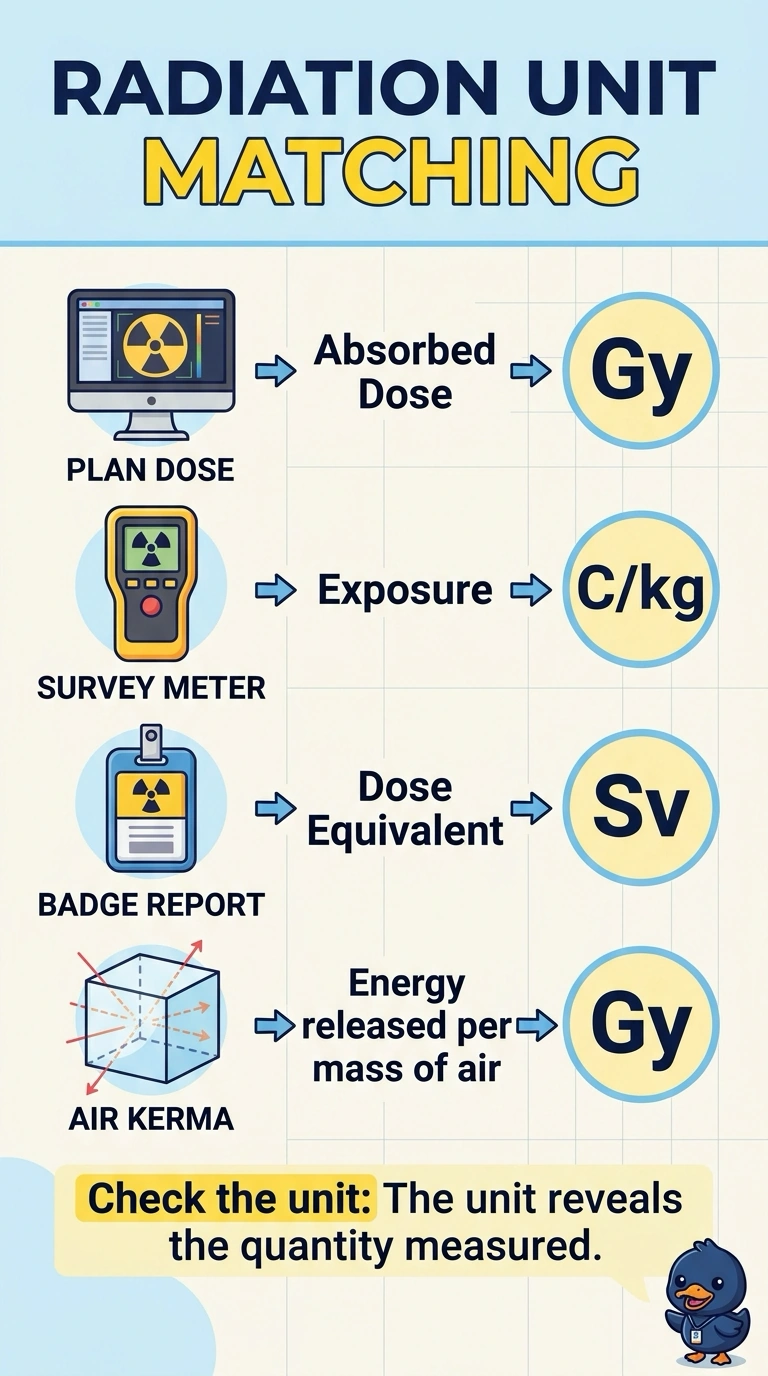
During weekly linac checks, a trainee notes three readings: the plan's prescribed target dose, a reading taken outside the vault with an ionization survey meter that reports exposure, and the monthly badge result from the dosimetry service. The physicist also asks for a reminder about air kerma. Which statement correctly matches each reading to its quantity and unit?
Select an answer to reveal the explanation.
Short Explanation
You matched each number to the quantity it really measures, and the unit is the giveaway every time. Gray counts energy absorbed in material, sievert carries a biological weighting, and coulomb per kilogram counts ions made in air. Name the unit first and you'll know what you're holding.
Full Explanation
Each reading describes a different physical quantity, and the unit tells you which one you are holding: gray measures energy absorbed per unit mass in the material, sievert carries a radiation or quality weighting for risk, and coulomb per kilogram measures ionization produced in air. The plan's prescribed target dose is absorbed dose, so it belongs in gray; the survey meter integrates ionization in air, which is exposure expressed in coulomb per kilogram; and the badge reports a weighted quantity for the worker, so sievert is the correct family. Reporting effective dose in gray drops the weighting factor that gives the number meaning; assigning sieverts to the meter reading imports a radiation weighting the instrument never applied; and labeling the plan dose as dose equivalent implies a conversion occurred when the calculation stayed in absorbed dose. Exam caveat: air kerma is also reported in gray, so the unit alone will not separate it from absorbed dose, and the stated quantity must do that. Practical check: name the quantity first, then confirm the unit matches it before comparing numbers.