
During a chart check you see a tolerance column listing TD 5/5 values for the spinal cord, lungs and kidneys beside the prescribed dose. The team is confirming that each critical structure stays within tolerance. Which statement correctly interprets a TD 5/5 tolerance value?
Select an answer to reveal the explanation.
Short Explanation
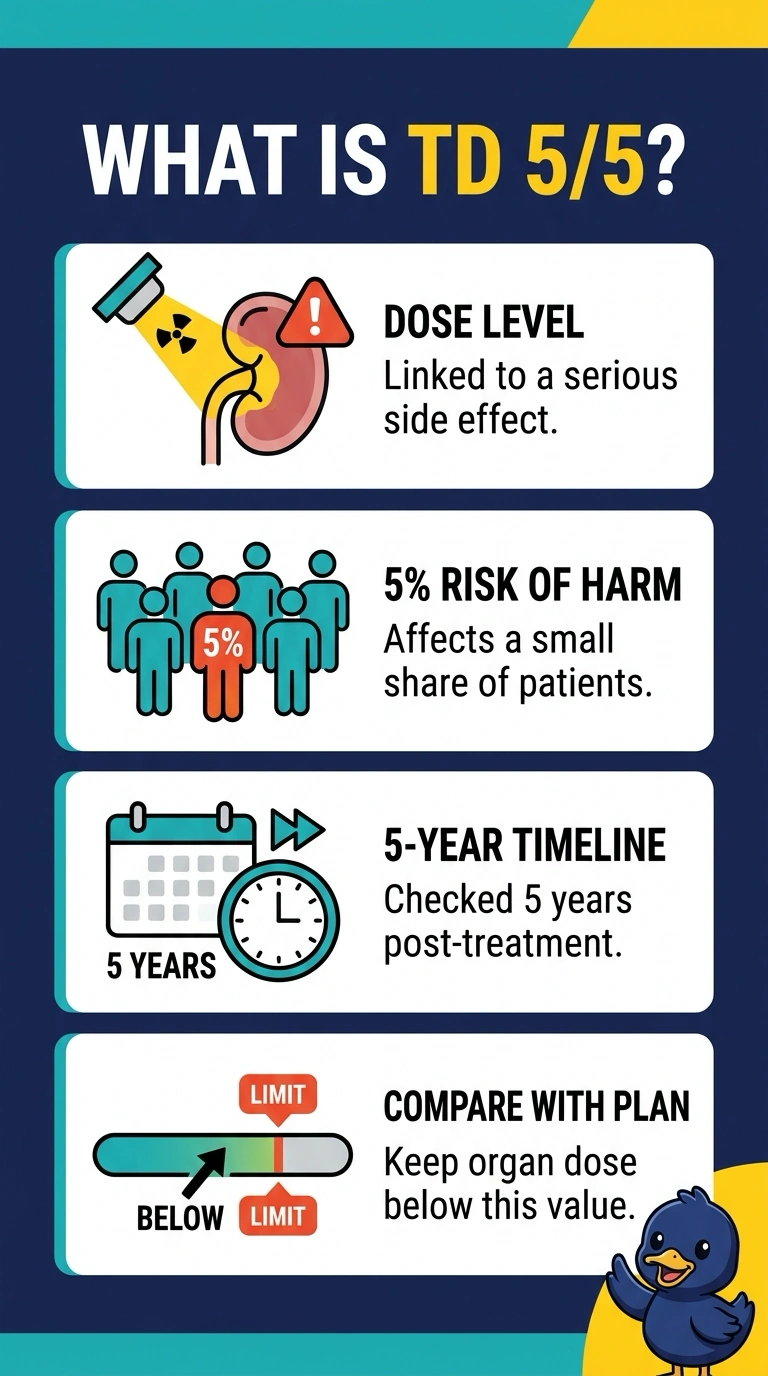
A TD 5/5 value is a risk statement about patients, not a slice of tissue or a tumor cure rate. It names the dose tied to one listed complication in a small share of patients within five years. You'll find it useful as a tolerance budget you check each plan against.
Full Explanation
The TD 5/5 notation is a population risk statement: it is the dose associated with the named serious complication in about five percent of patients five years after treatment, so a plan that keeps a critical structure below the listed value is expected to hold that complication rate under five percent. Reading it as the share of patients who remain complication free reverses the risk, because five percent is the group affected rather than the group spared, which flips the meaning entirely. Treating it as a volume statement confuses a whole-organ tolerance with a dose-volume limit, since TD 5/5 describes the organ as a whole rather than a fraction of its tissue. Using it as a tumor control figure mixes normal tissue tolerance with treatment response, and those are entirely different probabilities measured for different endpoints. These values come from pooled outcome data, so they guide planning rather than guarantee any one patient's outcome. The exam caveat is that the same organ may be listed with both a TD 5/5 and a TD 50/5 value, so check which risk level the question names before you compare anything. As a practical check, ask aloud how many patients are affected, by when, and of what.