
During review of a prostate plan, the physician notes that the highest posterior dose lands on a hollow pelvic organ and asks the planner to pull up its dose-volume limits for late toxicity. Which organ should be evaluated for those limits?
Select an answer to reveal the explanation.
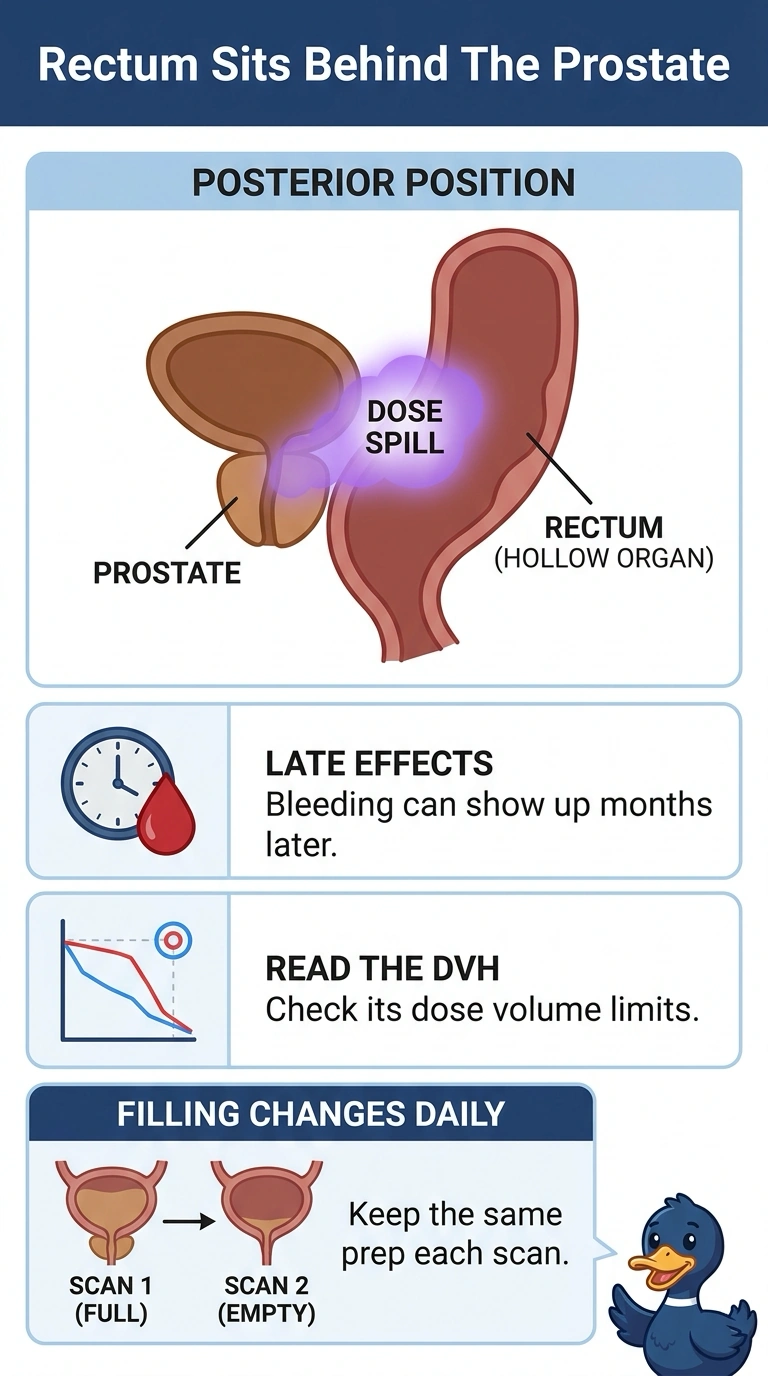
Short Explanation
You should check the rectum, which sits right behind the prostate and can receive posterior dose spill, raising the risk of late effects like bleeding or proctitis. The bladder is more like the organ in front of the target, while bowel limits matter when bowel is included in the treated area.
Full Explanation
The rectum lies immediately posterior to the prostate, so posterior dose spread can expose the rectal wall to late effects such as bleeding or urgency, which may appear months to years after treatment. Rectal dose-volume limits are commonly reviewed during prostate plan evaluation, but the specific structures and contour definitions depend on the treatment protocol. The bladder is also an important organ at risk for prostate planning, but it is anterior to the gland, so it does not match the posterior relationship described. The sigmoid colon is higher in the pelvis, where it joins the rectum, and small bowel may be relevant when loops are within the treated region. Some clinics outline the rectum alone and others include the rectosigmoid junction, so follow the applicable protocol. For a practical check, confirm that the dose-volume histogram is being read for the intended rectal structure and that the relevant in-field length is contoured.