
A patient is simulated for breast-conserving treatment of a 3 cm mass in the upper outer quadrant of the right breast, and the surgeon has documented a positive level I axillary sentinel node. The oncologist wants the first-echelon drainage basin confirmed before contouring. Which lymphatic drainage pattern should the team expect from this tumor?
Select an answer to reveal the explanation.
Short Explanation
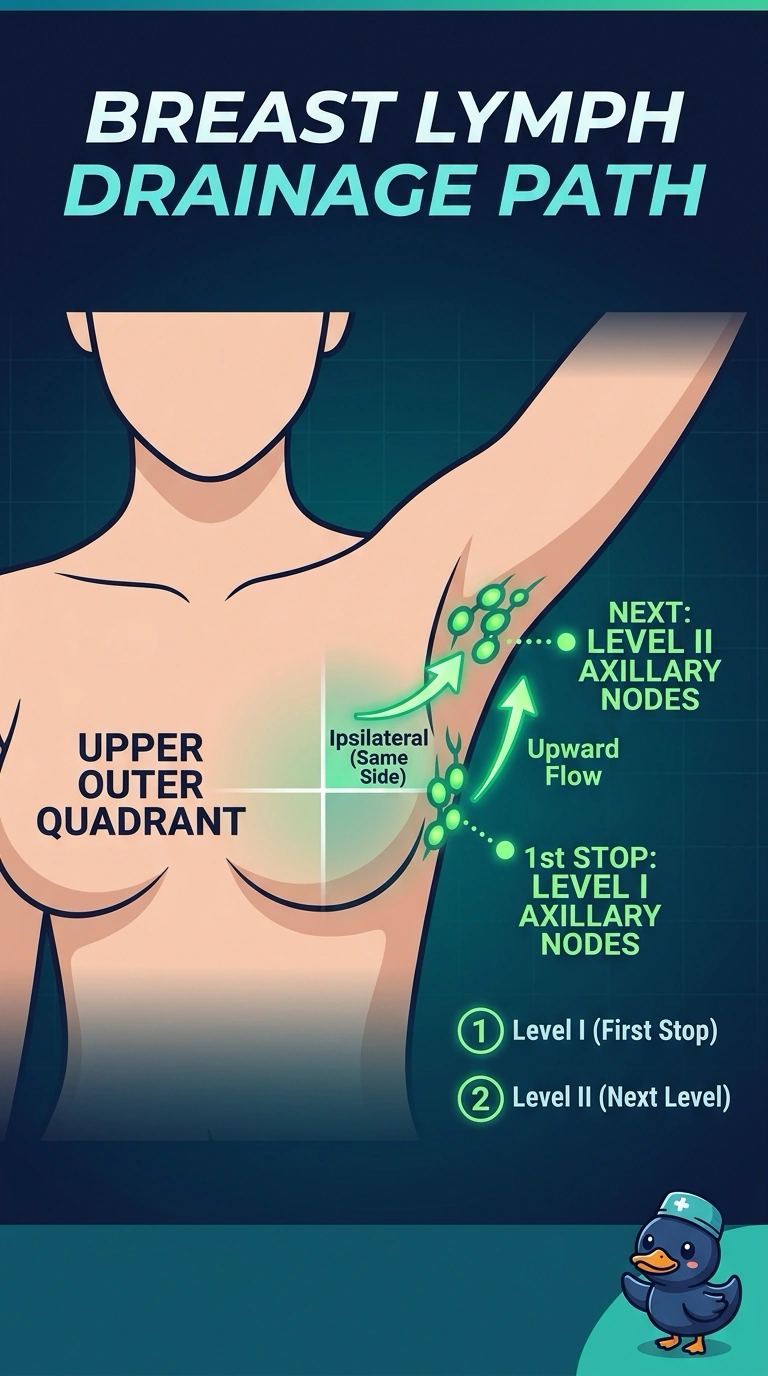
You can expect most lymph from the tumor’s upper outer quadrant to reach the same-side level I axillary nodes first, then level II. Like a neighborhood stop before a larger hub, level I is the first-echelon basin.
Full Explanation
The expected first-echelon basin is the ipsilateral level I axilla: the upper outer quadrant commonly drains laterally to level I before lymph progresses to level II, and the documented positive level I sentinel node is consistent with that route. The internal-mammary-first pattern is a recognized drainage route, especially for medial breast tumors, but it does not fit this upper-outer-quadrant primary as the expected predominant pathway; axillary drainage may still occur. The subareolar plexus is a real collecting network that can convey lymph from central breast tissue to axillary nodes, but the tumor is not central, so that location-specific route does not answer the scenario. Likewise, internal mammary drainage is plausible for a lower-inner-quadrant tumor, but the stated lesion is upper outer, making that route an inappropriate expectation here. Exam caveat: breast drainage is variable, and quadrant predicts predominant rather than exclusive drainage; medial or central tumors can also drain to axillary nodes, and lateral tumors may have additional pathways. A practical check before contouring is to review the operative sentinel-node mapping and imaging, confirming the documented nodal level and laterality rather than inferring the patient's individual drainage solely from quadrant.