
For a lung patient, the plan's registration instructions specify matching the tumor's soft-tissue edge on each daily image, but the automated match this morning locks onto the spine. Which check best validates the registration before the beams are treated?
Select an answer to reveal the explanation.
Short Explanation
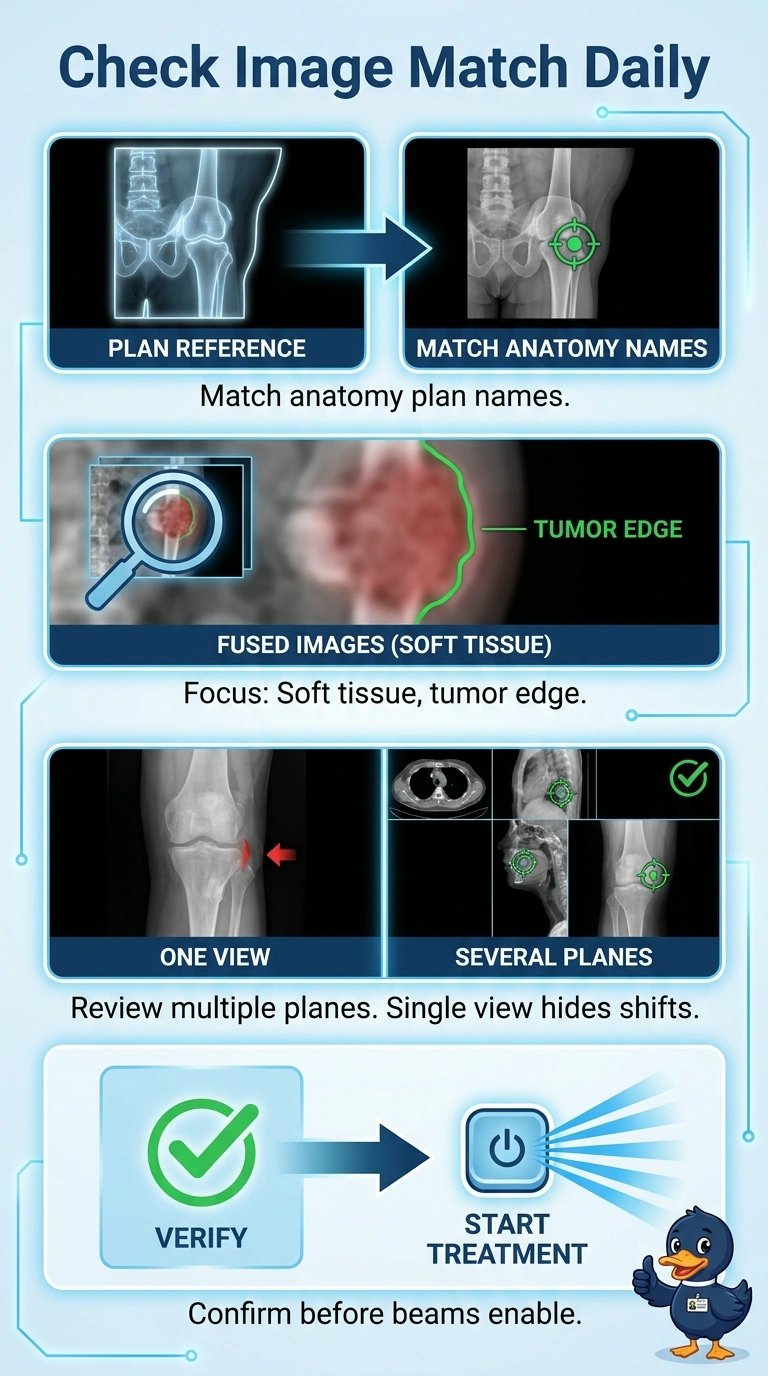
You’ll want to confirm the physician-approved reference and review the fused images in several planes before treatment—like checking a map from more than one angle instead of trusting the first pin the software drops. That verifies the registration in clinical context, even when the automated match grabs the spine.
Full Explanation
A registration should be judged against the reference structure named in the plan. An automated algorithm may lock onto a high-contrast edge that is not the intended reference, and a spine match that looks convincing in one plane may not show the target's position in other planes. Confirming the approved anatomy and reviewing the fusion in several planes can help identify a plausible-looking mismatch and validate the registration. Accepting a bony match within tolerance ignores the specific registration instruction written for this plan; reproducible anatomy is not necessarily the correct anatomy for the match. Matching tattoos to lasers verifies external setup, but does not by itself confirm internal position. Having a second therapist repeat the same automatic match does not independently test its accuracy. Exam caveat: image-guidance questions often hinge on which structure is being matched and who defined the reference, not on the software brand. Practical check: before releasing the beam, identify the approved structure, review the fusion in more than one plane, and confirm the shift against the plan.