
Two lung plans deliver the same prescribed dose to the same small lung target, and the multileaf apertures are nearly identical, yet a plan quality check flags higher out-of-field dose in the plan with wider jaw openings. Which beam adjustment should be made to lower dose to healthy tissue while target coverage stays unchanged?
Select an answer to reveal the explanation.
Short Explanation
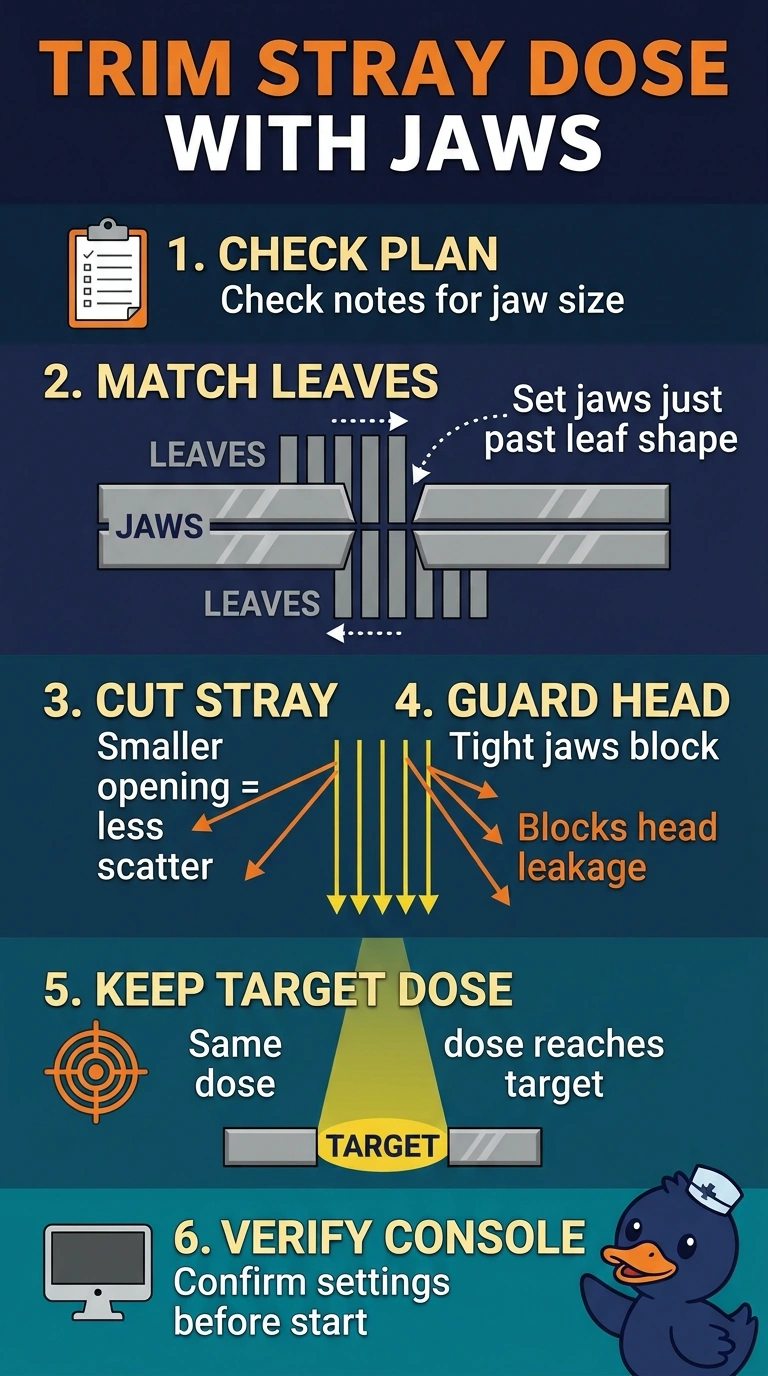
Your jaws sit above the leaves, so leaving them wide lets the beam cross leaf area the plan never treats. Pulling them in to the aperture trims transmission and scatter outside the field while your target dose holds. It's like cinching a loose collar, the cheapest collimation fix in the department.
Full Explanation
The correct adjustment is to bring the jaws close to, but just outside, the MLC aperture. This limits radiation passing through the jaws and reduces head scatter reaching healthy tissue, while the leaves continue to define the treatment field and target coverage can remain unchanged. Reducing monitor units through reoptimization can lower some leakage and scatter, but it does not correct the unnecessarily wide jaw openings identified by the check; the implicated jaw-related contribution therefore remains. An FFF beam can reduce head scatter and may lower peripheral dose, but changing the beam mode while retaining wide jaws does not address the specific field-size cause flagged here. More MLC shielding can reduce transmission through the leaves, yet it likewise leaves the wide-jaw contribution intact and may require careful preservation of the planned aperture. Exam caveat: peripheral-dose changes depend on beam energy, delivery technique, and distance from the field, so a general reduction in one component does not guarantee a lower dose at every out-of-field point. Practical check: after jaw adjustment, recalculate or measure the plan and confirm target coverage, dose constraints, and jaw-to-MLC clearance for every control point or segment.