
During peer review of a lung plan, the physicist notes that the evaluation structure was built from the microscopic disease volume and then expanded for setup uncertainty and respiratory motion. The physician asks which prescription volume the plan should be judged against. Which target volume is being described?
Select an answer to reveal the explanation.
Short Explanation
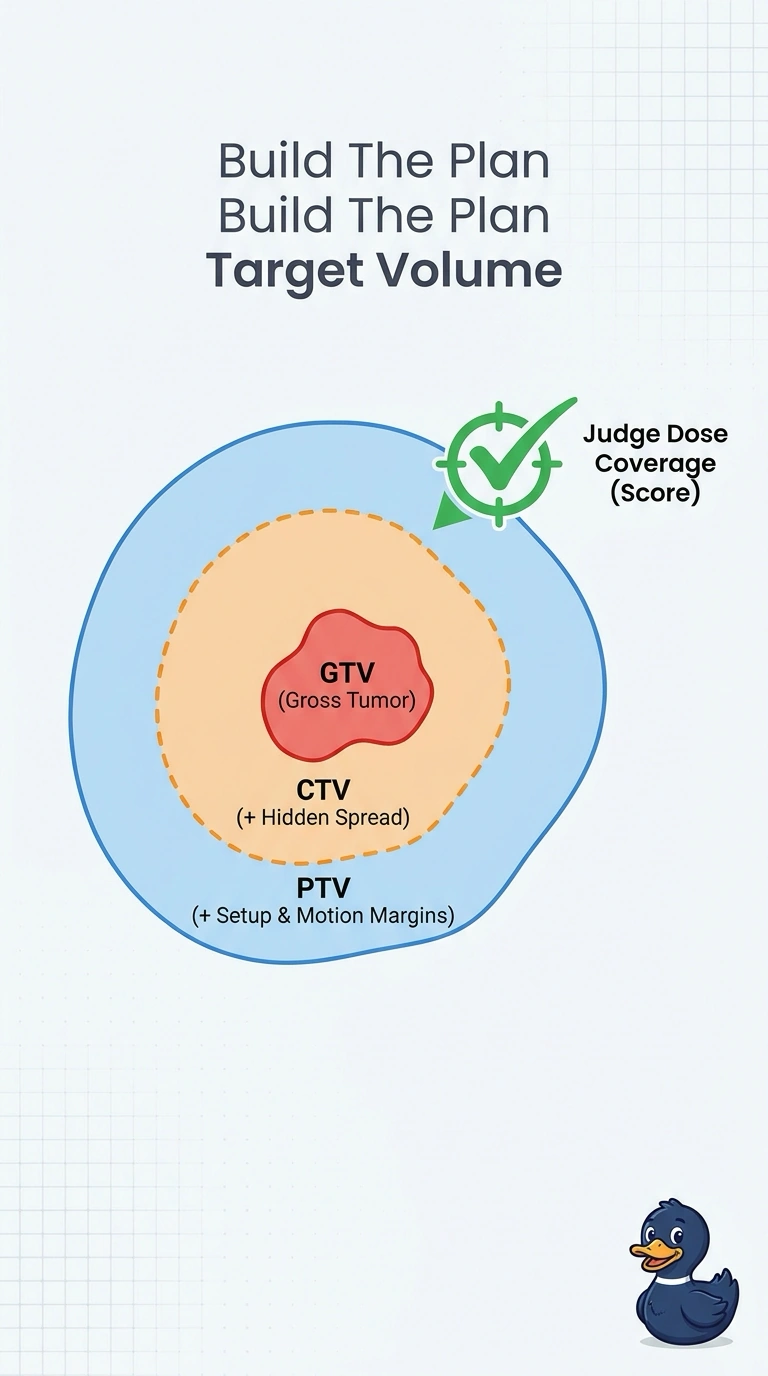
You score coverage against the PTV, because it accounts for setup uncertainty and breathing motion in addition to the clinical target. The GTV describes gross demonstrable disease, the CTV includes the clinical target for microscopic spread, and the ITV accounts for internal motion but not setup uncertainty.
Full Explanation
The planning target volume is what you judge coverage against. It is built from the clinical target volume, which includes gross tumor and any area at risk for microscopic disease, with margins to account for internal motion and setup variation. The gross tumor volume describes demonstrable tumor and does not include those margins. The clinical target volume accounts for subclinical disease but does not include setup or internal-motion margins. The internal target volume accounts for internal motion, such as respiratory motion, but does not include the setup margin used to form the PTV. In lung planning, an internal target volume may be contoured before the planning margin is added. Confirm which structure includes the planning margin, and assess coverage on that structure.