
A resident reviewing a linac commissioning report finds a target absorbed dose, a whole-body effective dose from scatter, an exposure reading from a survey meter, and an in-air kerma measurement. The physicist wants each quantity classified before the report is signed. Which statement correctly gives the unit used to report each quantity?
Select an answer to reveal the explanation.
Short Explanation
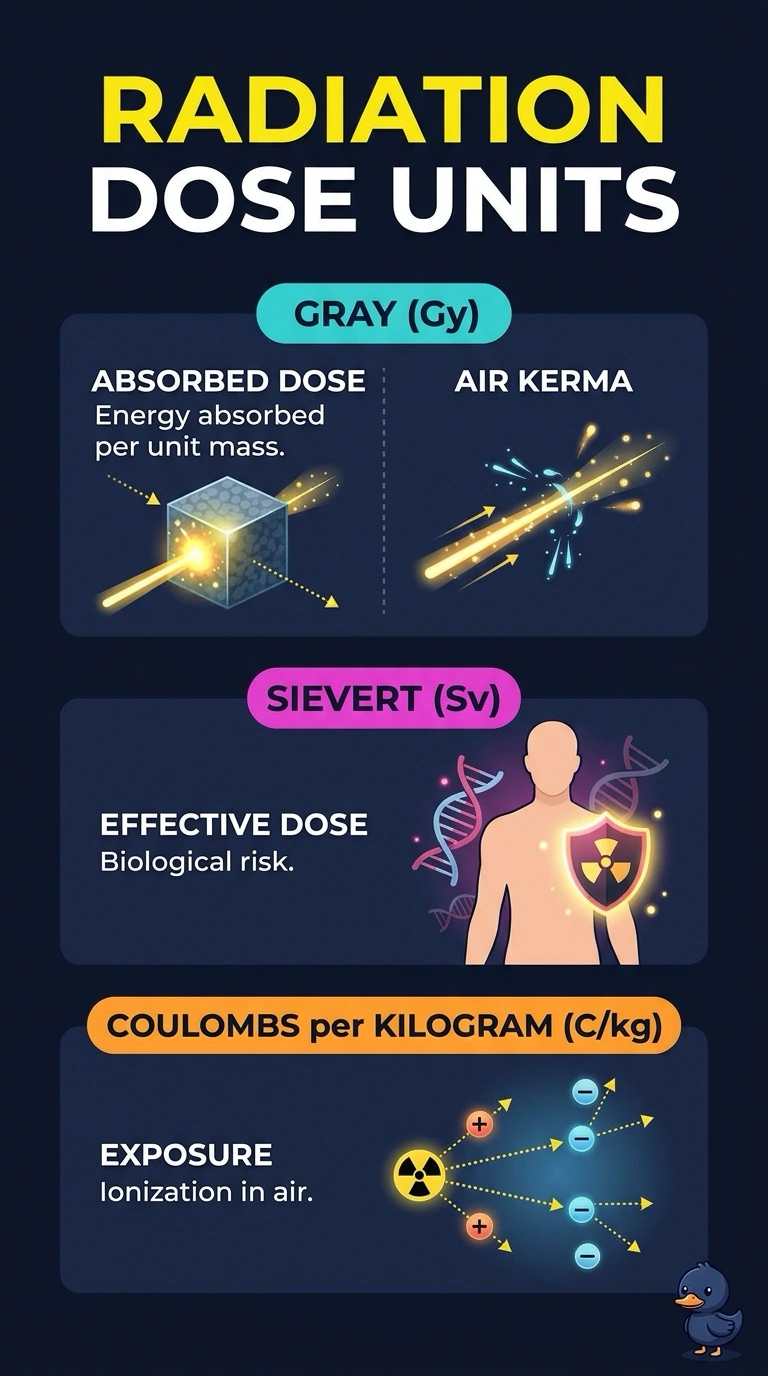
You paired each unit with the quantity it really measures, which is the whole game. The gray counts energy absorbed in matter, while the sievert adds a weighting for biological harm, so the two can't be swapped. Exposure is a different idea entirely: charge made in air, reported in coulombs per kilogram.
Full Explanation
Each unit follows from what the quantity describes: absorbed dose is energy deposited per unit mass in a medium and is reported in grays, and air kerma is energy transferred per unit mass of air, so it is also reported in grays. Exposure measures the charge of one sign produced in air by photons per unit mass, so its unit is coulombs per kilogram. Effective dose is calculated using radiation and tissue weighting factors and is reported in sieverts. Labeling air kerma in sieverts fails because no weighting factor is applied when kerma is measured. Assigning exposure to grays fails because a gray describes energy per unit mass rather than ionization charge. Treating effective dose as unweighted energy deposition fails because effective dose applies tissue weighting factors. Exam caveat: gray and sievert values can be numerically equal in particular circumstances, such as when the relevant radiation and tissue weighting factors yield equality; the units still describe different quantities. Practical check: name the quantity first—energy deposited, energy transferred, charge in air, or weighted dose—and the correct unit follows.