
Before the first fraction of a chest wall plan you check the printout and find four modifiers: a physical wedge, an accessory tray, a bolus sheet over the scar, and lung in the beam path. Each one should have been handled in the prescribed dose calculation. Which statement correctly describes how these four modifiers affect the dose at the treatment site?
Select an answer to reveal the explanation.
Short Explanation
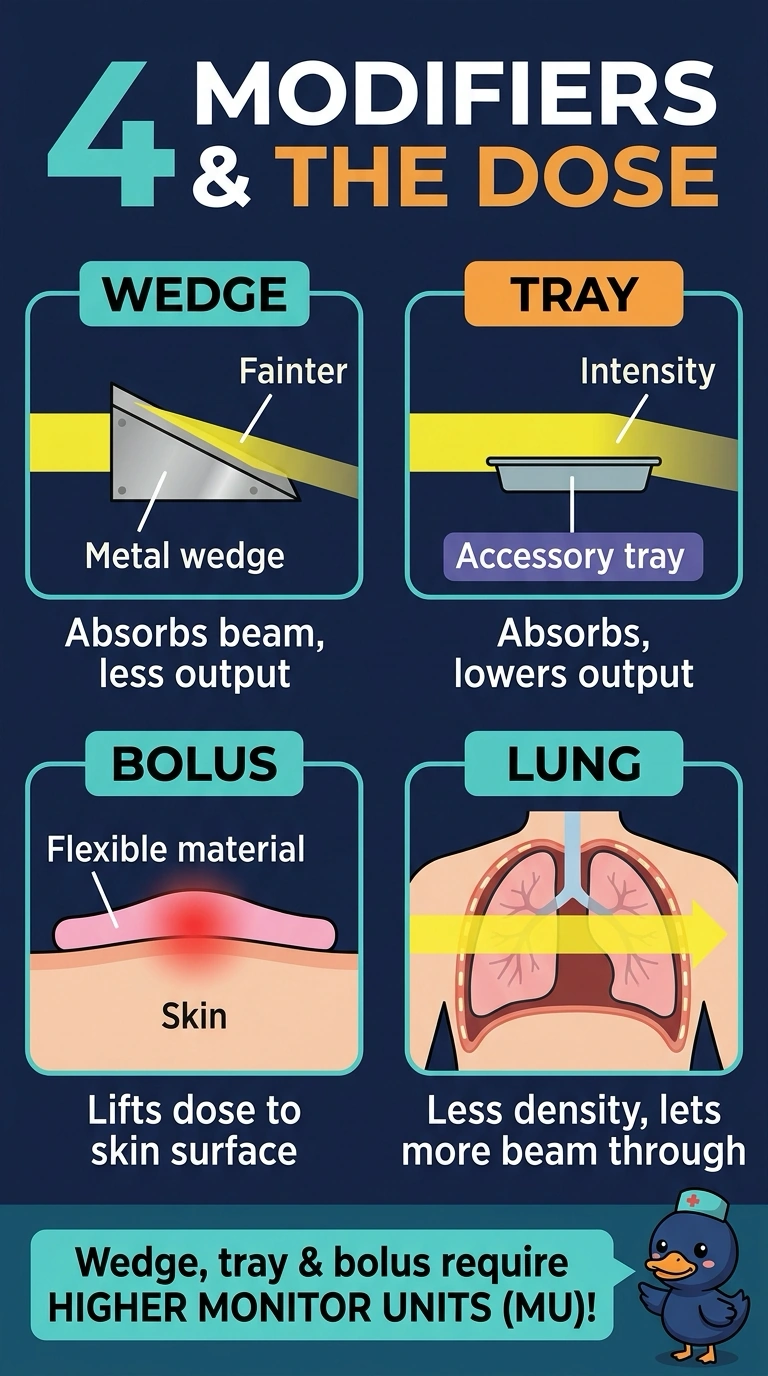
You’re checking four effects that change how much radiation reaches the treatment site and where the dose builds up. Wedges and trays absorb photons, bolus raises surface dose, and lung attenuates less than unit-density tissue. The transmission of each modifier needs to be represented in the calculation.
Full Explanation
The correct statement describes all four effects: a physical wedge and an accessory tray absorb photons and reduce primary-beam fluence; bolus acts as tissue-equivalent material over the scar and increases dose buildup at the surface; and lung tissue attenuates less than an equal thickness of unit-density tissue. A statement that a wedge hardens the beam but represents its transmission only through the beam profile is incomplete: spatial shaping does not account for the wedge’s transmission loss in the dose calculation. A statement that tray attenuation is scatter-only also fails, because tray material absorbs primary photons as well as affecting scatter. A statement that a thin bolus sheet is represented only as a buildup shift fails to account for the bolus material itself in the prescribed calculation. An exam caveat is that the size of these effects depends on beam energy, field geometry, material, and calculation method, so the qualitative directions do not give correction factors. In practice, check that the plan calculation accounts for wedge and tray transmission, represents the bolus sheet, and includes the lung heterogeneity correction.