
During a power outage, a therapist notices the survey meter in the sealed-source storage area still reads above background, while the accelerator vault reads normal with no power running. Which comparison between radioactive-source and machine-produced radiation explains this difference?
Select an answer to reveal the explanation.
Short Explanation
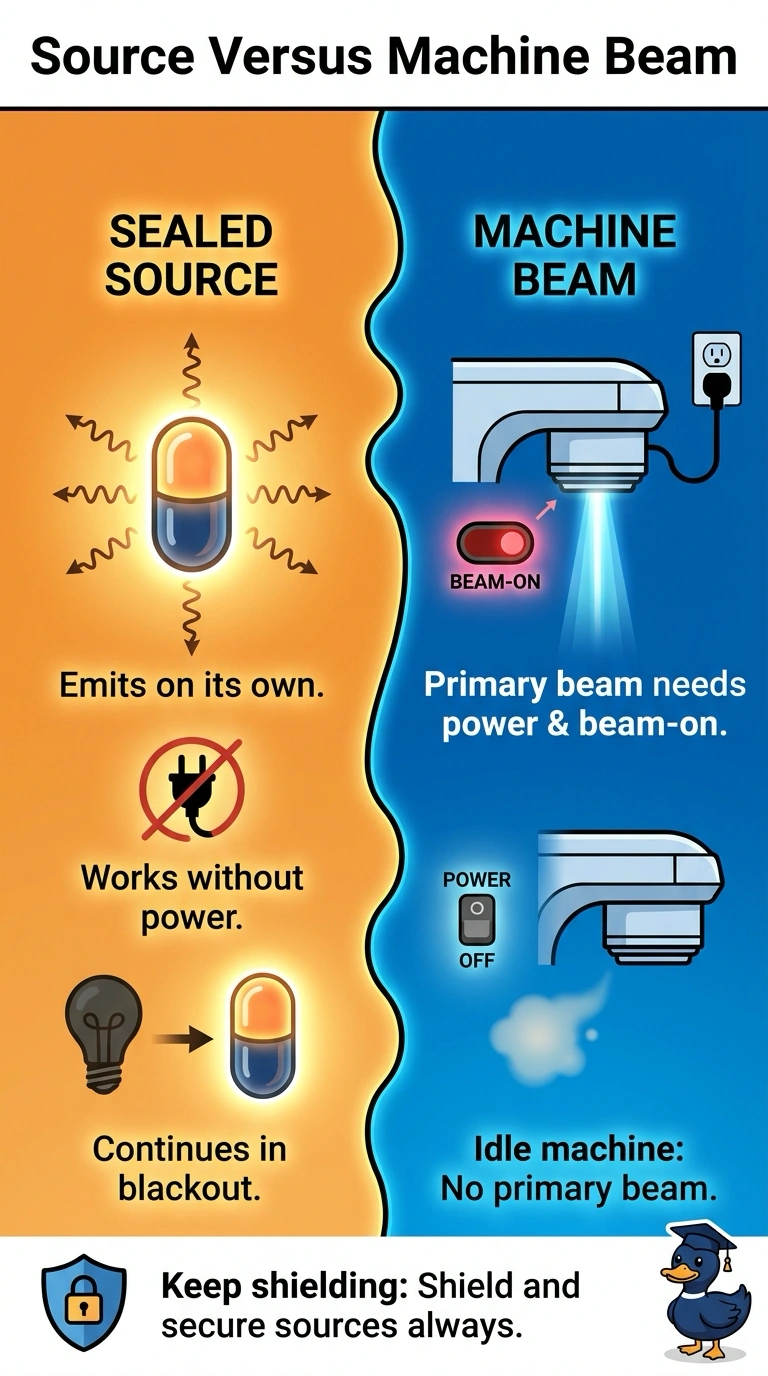
A sealed radioactive source keeps emitting as its atoms decay, so you can still detect it during a blackout—like a clock that keeps ticking. A linac needs power and the beam turned on to produce its primary photon beam, so spontaneous emission explains the difference.
Full Explanation
The comparison depends on how each radiation source produces radiation. A sealed radioactive source undergoes spontaneous nuclear decay, so it continues emitting whether or not the facility has electrical power; shielding and a closed shutter can reduce radiation outside its housing, but do not stop the decay. A linac’s primary therapeutic photon beam is produced when the powered accelerator operates with the beam on. When the accelerator is off, that primary beam is absent, explaining why the storage-area meter can remain above background while the vault reads normally. The claim that a sealed source emits only when its shutter is open confuses emission with containment: the shutter controls radiation escaping the source assembly, not whether the radionuclide decays. The claim that a primary photon beam can persist briefly after power is lost incorrectly treats beam production as stored radiation; the linac must operate to produce the beam. The claim that residual activation usually keeps a vault above background overstates activation: components can become activated, particularly at high energies, but that radiation is not the primary beam and does not ordinarily explain a persistent above-background reading in this scenario. Exam caveat: “sealed” means radioactive material is enclosed, not non-emitting; distinguish the primary beam, leakage, and activation products. Practical check: verify the source shutter and shielding status, confirm the linac is beam-off and de-energized, and compare readings with background at documented locations using the appropriate survey instrument.