
A 62-year-old patient newly diagnosed with Hodgkin lymphoma has biopsy-proven cervical and retroperitoneal lymph nodes; the staging workup shows no extranodal organ involvement, and the patient reports no fever, drenching night sweats, or weight loss. Using the Ann Arbor system, which statement correctly explains this patient's stage classification?
Select an answer to reveal the explanation.
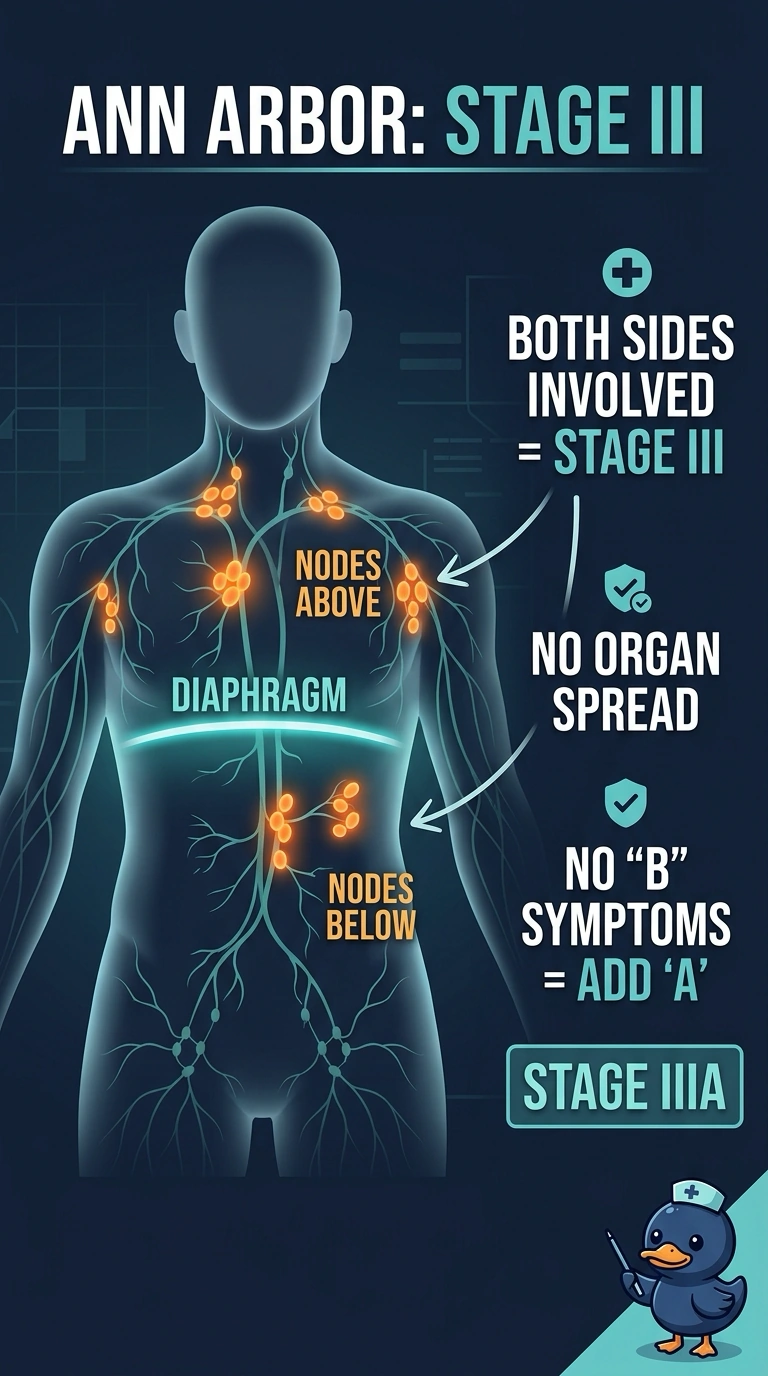
Short Explanation
Two facts decide this stage: where the nodes sit and whether disease escaped the lymphatic system. It's like a line drawn at the diaphragm, cross it on both sides with nodes and you're at stage III. Your A suffix simply records that you found no fever, drenching sweats, or weight loss.
Full Explanation
Ann Arbor sorts lymphoma by how far disease has spread through the lymphatic system. Nodal regions on both sides of the diaphragm, with no involvement of an organ outside the lymphatic system, define stage III, and the A suffix records that B symptoms, namely fever, drenching night sweats, and weight loss, are absent. Assigning stage II fails the anatomic concept, because that stage requires every nodal site to stay on one side of the diaphragm, and the retroperitoneal nodes sit below it. Assigning stage IV fails the extranodal concept, since stage IV requires dissemination to a tissue outside the lymphatic system, which this workup does not show. Adding a B suffix fails the symptom-classification concept, because the letter follows the patient's reported constitutional symptoms rather than the extent of nodal disease. Exam caveat: some texts also carry modifiers such as E for a limited extranodal site or S for splenic involvement, so recognize the letters but test the stage rules first. Practical check: list each involved region with its side of the diaphragm, then confirm the symptom letter before stating the stage.