
During plan review at a regional cancer center, a therapist reads the written prescription for a lung primary: a radical course of 6 MV photons given in daily fractions to a named target volume, while the plan summary lists the dose to a different volume. Which volume must be verified to confirm coverage of microscopic disease plus setup and breathing margins?
Select an answer to reveal the explanation.
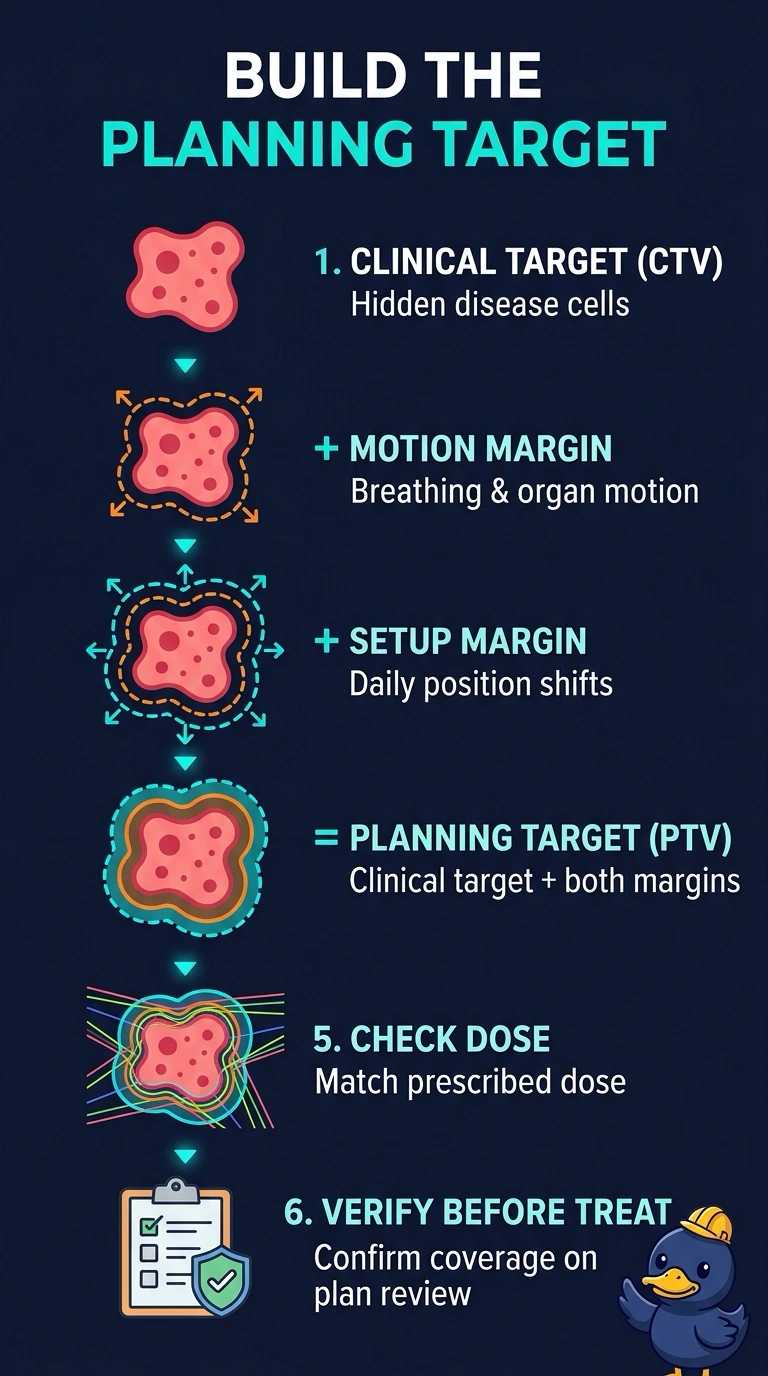
Short Explanation
Margins are the whole point of the volume name you're checking. The planning target volume is the clinical target volume plus setup and internal motion margins, so it's the benchmark you verify dose against. Call it the PTV and chart checks get a lot quicker.
Full Explanation
A prescription is complete only when dose, fractionation, beam energy, and the treated volume are all named, and the volume name carries the margins. The planning target volume is the clinical target volume, meaning gross disease plus suspected microscopic spread, with setup and internal motion margins added, so it is the volume whose coverage you confirm against the prescribed dose and schedule. Verifying the gross tumor volume fails the margin concept, because that contour stops at visible disease and ignores microscopic extension and every delivery margin. Verifying the internal target volume fails the setup-margin concept, since it accounts for breathing motion but not day-to-day positioning error. Verifying the clinical target volume alone fails the coverage concept, because it includes microscopic disease yet still omits the margins that treatment uncertainty requires. Exam caveat: prescriptions may name a target volume or a specific dose reference point, so read the written volume name instead of assuming. Practical check: match the volume named in the prescription to the volume the plan reports dose to before the first fraction.