
A patient with a peripheral right lower lobe tumor is simulated for stereotactic lung treatment, and scout images show the mass moving several millimeters with each breath. The team must choose an acquisition that captures this motion for treatment planning. Which CT simulation acquisition best represents this respiratory motion for treatment planning?
Select an answer to reveal the explanation.
Short Explanation
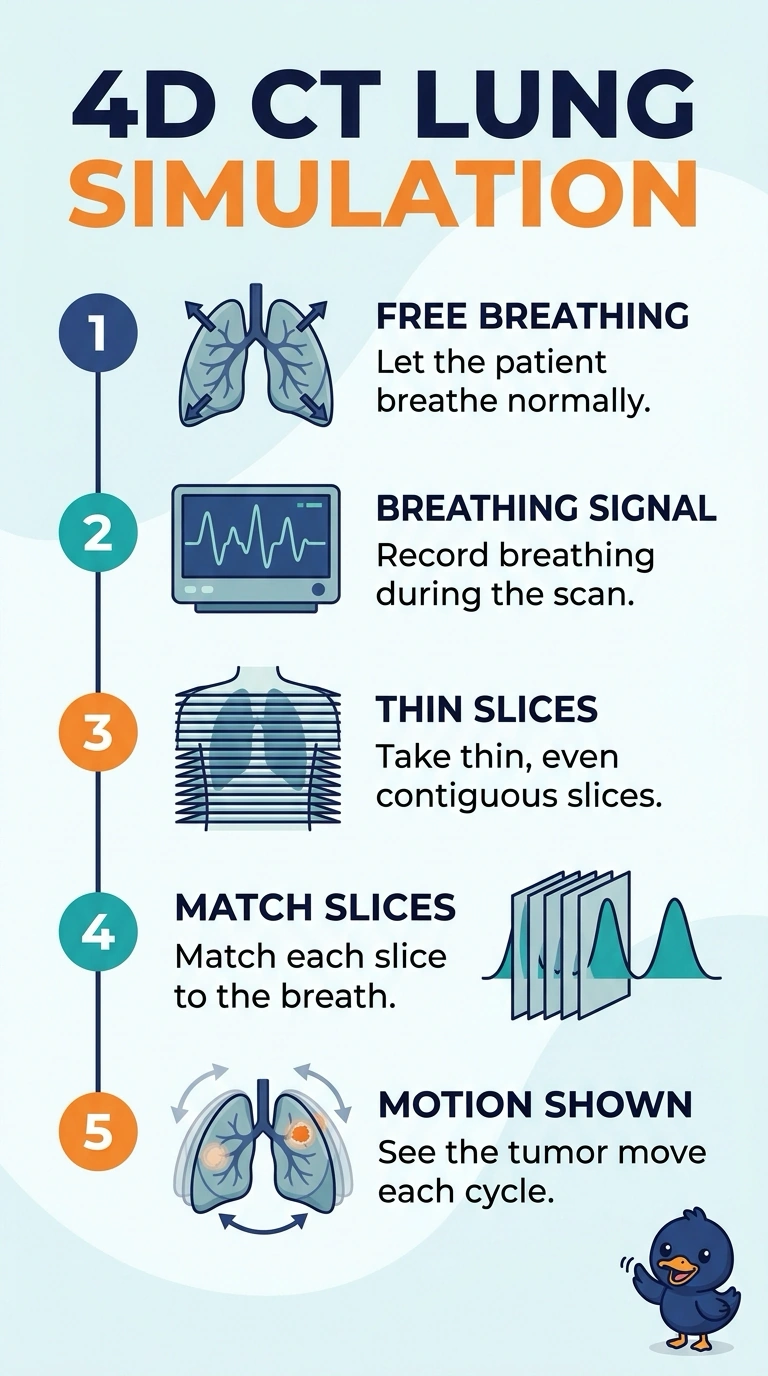
You picked the acquisition that records motion instead of estimating it. A 4D CT ties image data to the breathing signal, so you can see how the tumor position changes across the sampled breathing cycle. It's like shooting a flip-book of the breath instead of one snapshot.
Full Explanation
A respiratory-correlated 4D CT records a breathing signal during free breathing and sorts image data into respiratory phases, allowing the planner to estimate how the target moves over the sampled cycle. That motion information can guide internal target volume construction, margin decisions and dose planning around a moving lesion, so the acquisition should sample the respiratory cycle rather than capture only one instant. A single breath-hold approach captures one phase and does not show the tumor's excursion during free breathing. An unmonitored free-breathing helical approach has no respiratory information to associate with the images, so motion may be blurred or mixed across the dataset. A two-phase inspiratory-expiratory approach samples only two points and may miss intermediate positions and other motion patterns. Exam caveat: 4D imaging is used when motion matters; many brain, head and neck, and pelvic cases are planned from standard CT simulation. Practical check: confirm that respiratory information is available, acquisition parameters are appropriate, and the scan range covers the tumor over the breathing cycle.