
Midway through a thoracic fraction, an elderly patient suddenly becomes short of breath, reports sharp chest pain with each breath, and the oxygen saturation starts falling. Which immediate response to this acute breathing emergency should the treatment team take?
Select an answer to reveal the explanation.
Short Explanation
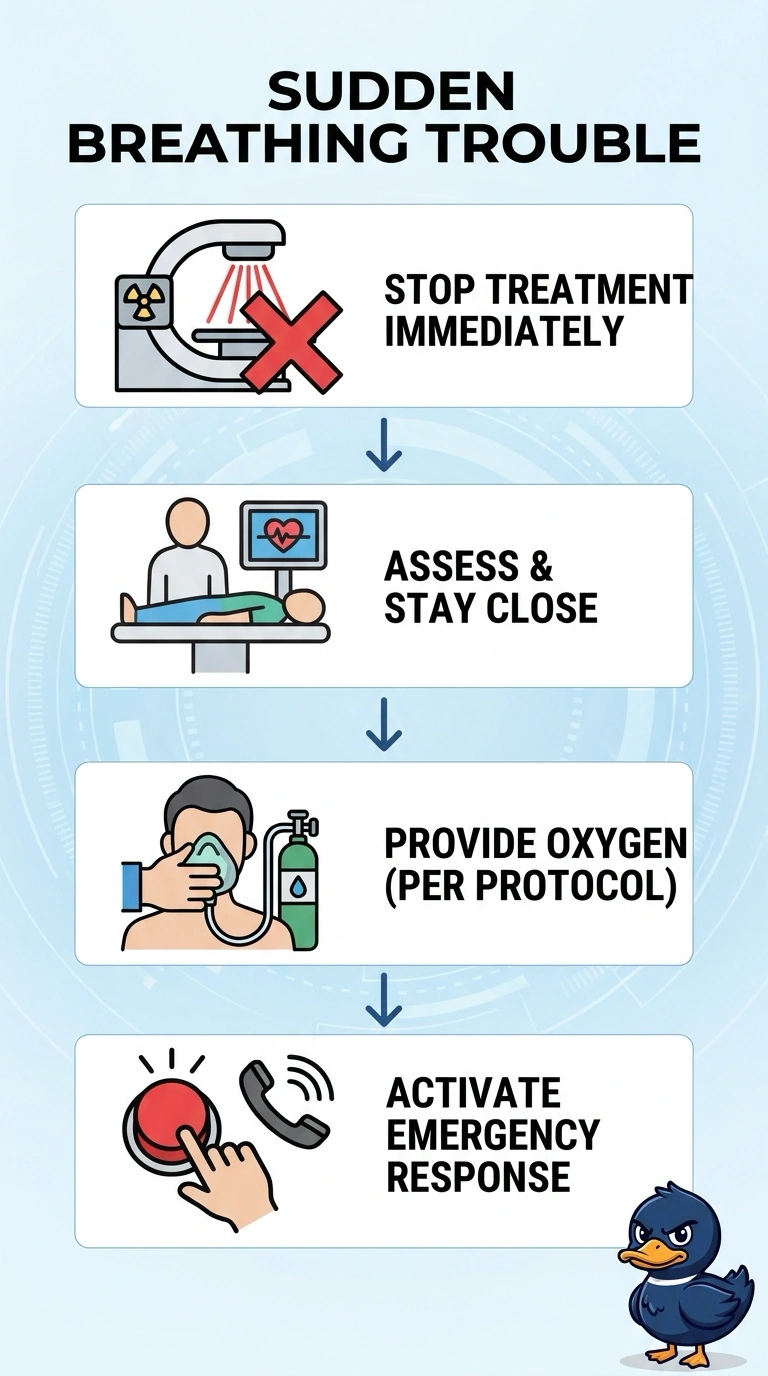
Sudden breathlessness, sharp pain with each breath, and falling oxygen can signal a pulmonary embolism—a warning that needs immediate attention. Stop treatment, assess and monitor your patient, provide oxygen according to protocol, and activate the emergency response; notifying a clinician, repositioning, or preparing for transfer does not replace this immediate response.
Full Explanation
The correct response treats this as an acute, potentially life-threatening deterioration: stop irradiation, promptly assess and monitor the patient, provide oxygen under local protocol, and activate the emergency response. Sudden dyspnea, pleuritic chest pain, and falling oxygen saturation during thoracic treatment warrant urgent evaluation rather than waiting to see whether symptoms settle. Stopping treatment, assessing and monitoring, providing oxygen, and urgently notifying the radiation oncologist for bedside review does not ensure activation of the emergency response needed for rapid assessment and escalation. Stopping treatment, sitting the patient upright, assessing and monitoring vital signs, and activating emergency assistance addresses assessment and escalation but omits protocol-directed oxygen despite the falling saturation. Stopping treatment, providing oxygen, activating emergency help, and preparing for urgent transfer omits explicit assessment and monitoring while help is arriving; transfer preparation does not replace immediate bedside assessment. Exam caveat: oxygen delivery, positioning, and escalation should follow local emergency and oxygen-use protocols, and oxygen is not a substitute for identifying the cause. Practical check: confirm that the beam is off, stay with the patient, reassess airway, breathing, circulation, and saturation, and verify that emergency help has been activated.