
On a busy day the schedule includes a pre-transplant whole-body treatment, a skin-wide electron treatment for a widespread superficial condition, a temporary cavity implant, and a conventional localized external beam. The team briefly disagrees about which description belongs to the skin-wide treatment. Which description correctly identifies total skin electron irradiation?
Select an answer to reveal the explanation.
Short Explanation
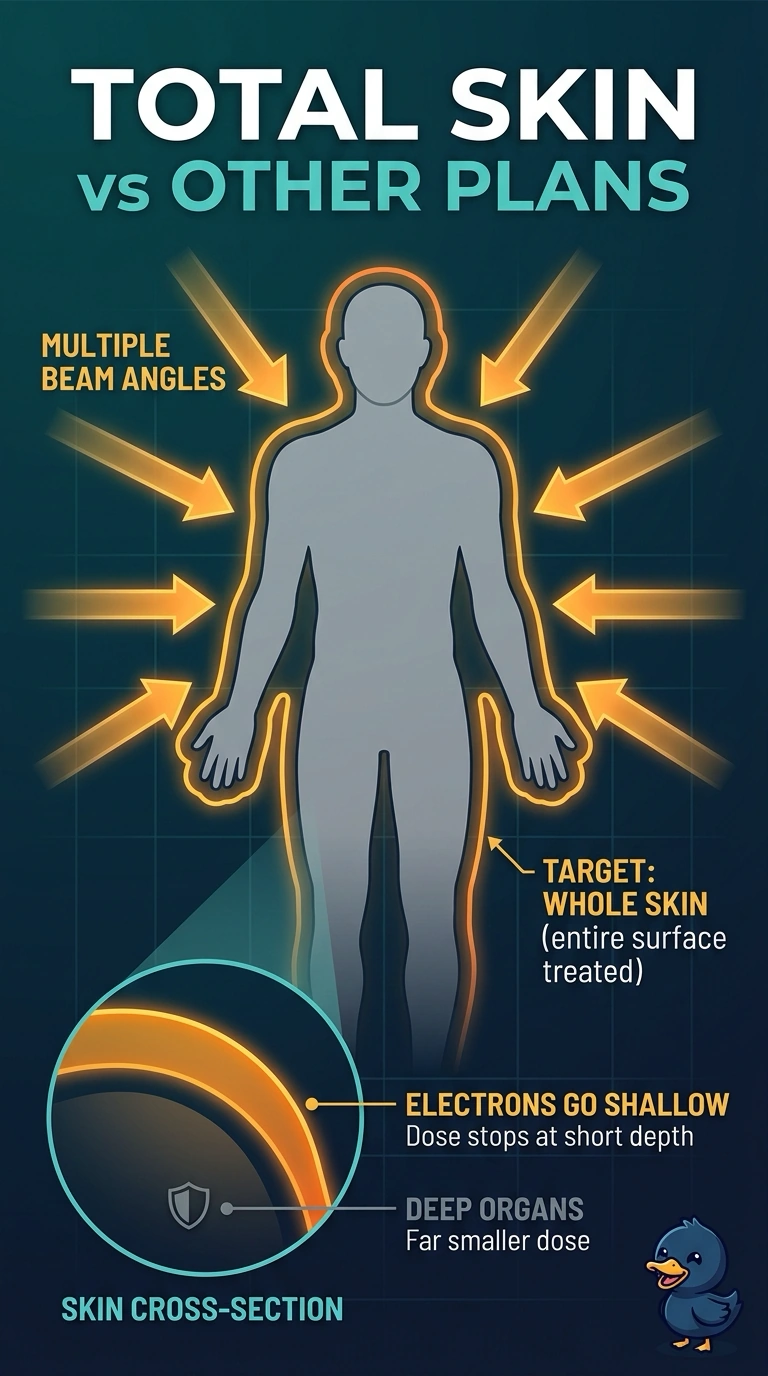
Electrons run out of energy after a short distance, so the skin takes the dose while deep organs get very little. When you line it up against a true whole-body prescription, that shallow reach is what sets the skin-wide treatment apart. It all comes down to electron range.
Full Explanation
Total skin electron irradiation relies on the shallow penetration of electrons, so the treatment covers the whole skin surface while the limited range keeps marrow, lung and other deep organs at a far smaller dose than the skin receives. Treating the entire body as a single target volume describes total body irradiation, where high-energy photons clear the marrow before transplant, and that prescription has different goals, setup and limits. A sealed source placed temporarily in a body cavity describes brachytherapy basics, where dose falls away steeply with distance from the source instead of covering a broad surface. A single external beam aimed at one defined site describes conventional external beam treatment of a localized target such as breast or prostate. Because electrons stop at a shallow depth, the plan is written for the skin surface rather than for a deep organ target. The exam caveat is that both skin-wide and whole-body treatments span most of the patient, so read carefully whether the target is named as skin or as the whole body, since the words sound alike in a fast review. A practical check is to ask which tissue is the target: surface, whole body, cavity, or one organ.