
A patient is treated on a setup where the entry surface slopes, so tissue thickness varies across the treatment area. The physicist wants the dose at the prescription depth to be uniform across the field while the beam arrangement and field size stay unchanged. Which beam modifier best accomplishes this?
Select an answer to reveal the explanation.
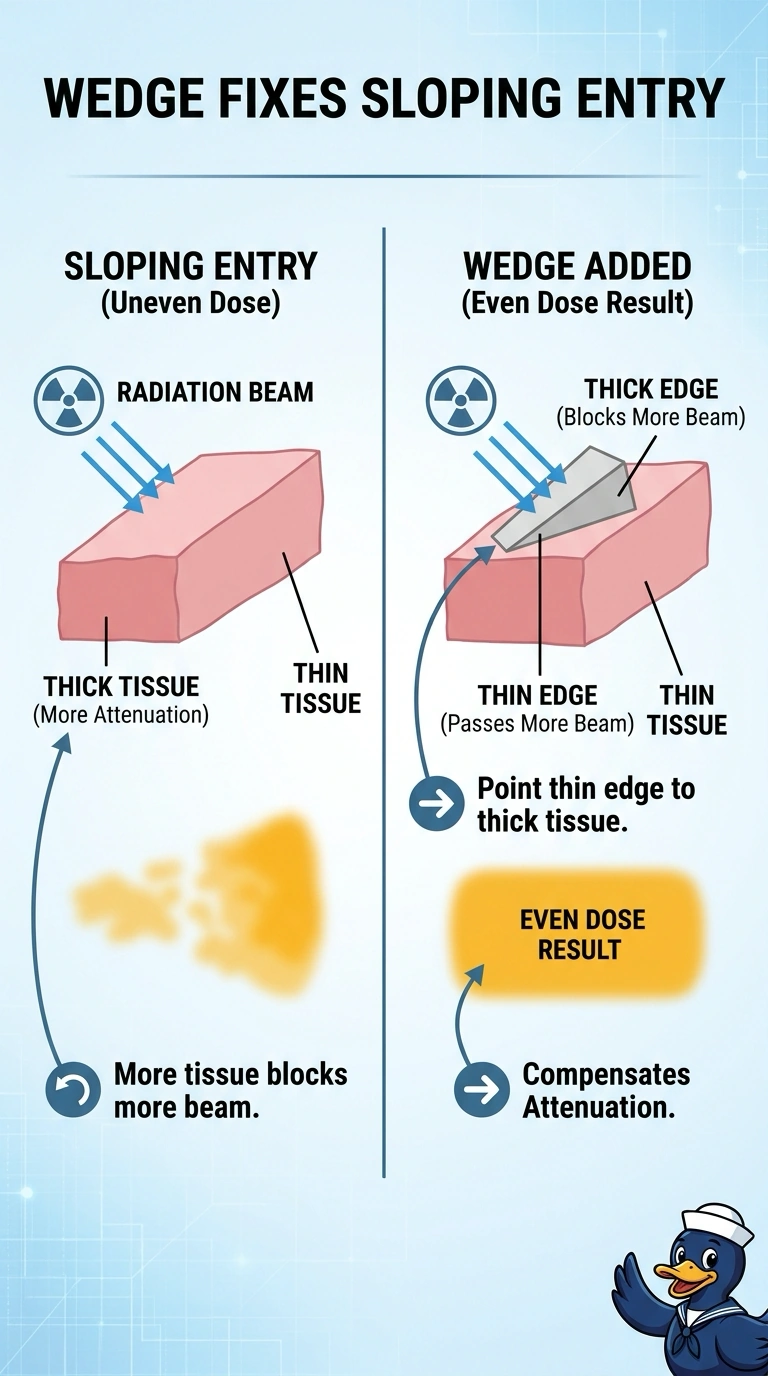
Short Explanation
You can think of a wedge as a gentle ramp in dose: with its thin edge toward the thicker tissue, it compensates for extra attenuation and helps keep dose even at prescription depth. Your beam arrangement and field size stay unchanged, making this a beam modifier.
Full Explanation
When the entry surface slopes, tissue thickness varies across the field, so one part of the target attenuates more of the beam and the dose at prescription depth can become uneven. A wedge introduces a deliberate dose gradient; its thin edge faces the thicker tissue, compensating for the extra attenuation on that side and helping make the dose uniform at depth. A bolus sheet over the thinner entry region increases surface buildup, but it does not correct the thickness-related dose gradient within the field. Asymmetric jaw settings reshape or narrow the field over the thinner side, changing the requested field geometry and removing beam rather than redistributing its intensity to compensate at depth. Changing beam weighting adjusts the relative contribution of the anterior beam, addressing dose balance between beams rather than the gradient across this field, and changes the beam arrangement. Exam caveat: judge wedge orientation by the relative tissue thickness across the field, not simply by a named patient direction; the thin edge must face the thicker tissue. Practical check: before treatment, confirm that orientation and verify the wedge factor in the record-and-verify system.