
During a simulation conference for a patient with a 3 cm invasive tumor in the upper outer quadrant of the left breast and no palpable adenopathy, the team must decide which nodal regions to contour on the planning CT. Which lymphatic drainage pattern correctly guides that contouring decision?
Select an answer to reveal the explanation.
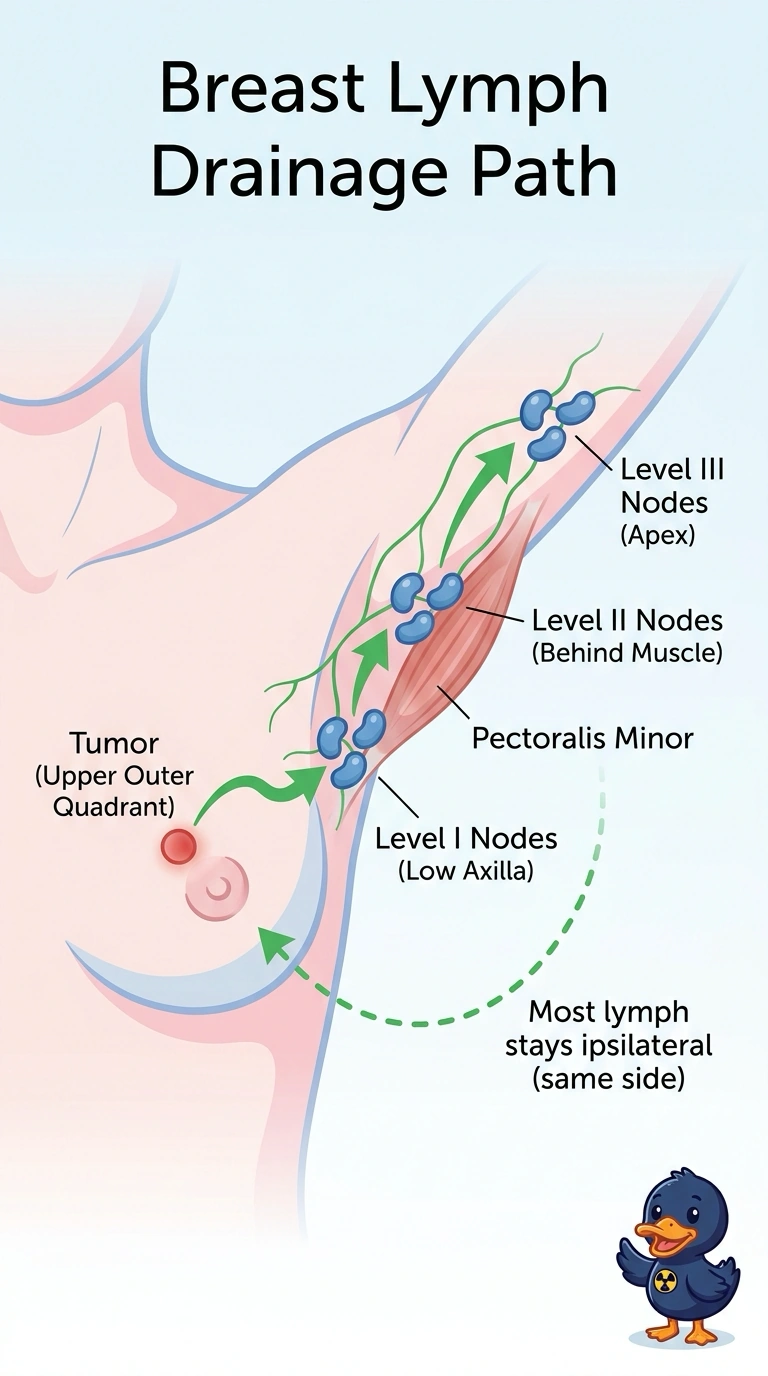
Short Explanation
Most lymph from an upper outer breast tumor drains first to the level I and II axillary nodes on the same side as the tumor. These ipsilateral nodes are like the first stop on lymph’s route out of the breast.
Full Explanation
For an upper-outer-quadrant breast tumor, the usual first-echelon drainage is to the ipsilateral level I axillary nodes, with drainage commonly extending to level II; the axillary basin receives most breast lymph. This pattern supports considering the axillary levels when defining nodal anatomy, while the final treated regions depend on the clinical indication and plan. Internal mammary drainage is a recognized pathway, but emphasizing it as the first route here misapplies the pattern most associated with medial or central tumors and does not reflect the usual first drainage for this lateral lesion. Supraclavicular nodes are a regional nodal target in selected cases, particularly when nodal involvement or other risk factors support regional treatment, but they are not ordinarily the first drainage basin from the breast. Level III nodes may be included in comprehensive nodal irradiation, yet they are higher in the axillary chain and are not the usual first-echelon site; placing them first reverses the typical sequence. Exam caveat: absence of palpable adenopathy does not exclude occult nodal disease or, by itself, determine whether elective nodal irradiation is appropriate. Practical check: correlate the clinical indication with imaging and any sentinel-node or surgical pathology findings, then verify the intended nodal volumes against the planning protocol.