
A patient with a right lower lobe lesion is being simulated for photon treatment, and the planning CT shows the lesion moving with quiet breathing. Immobilization and the scan range are already verified, and the physicist wants the full motion extent captured before contouring begins. Which CT acquisition approach will capture the full motion extent the physicist needs?
Select an answer to reveal the explanation.
Short Explanation
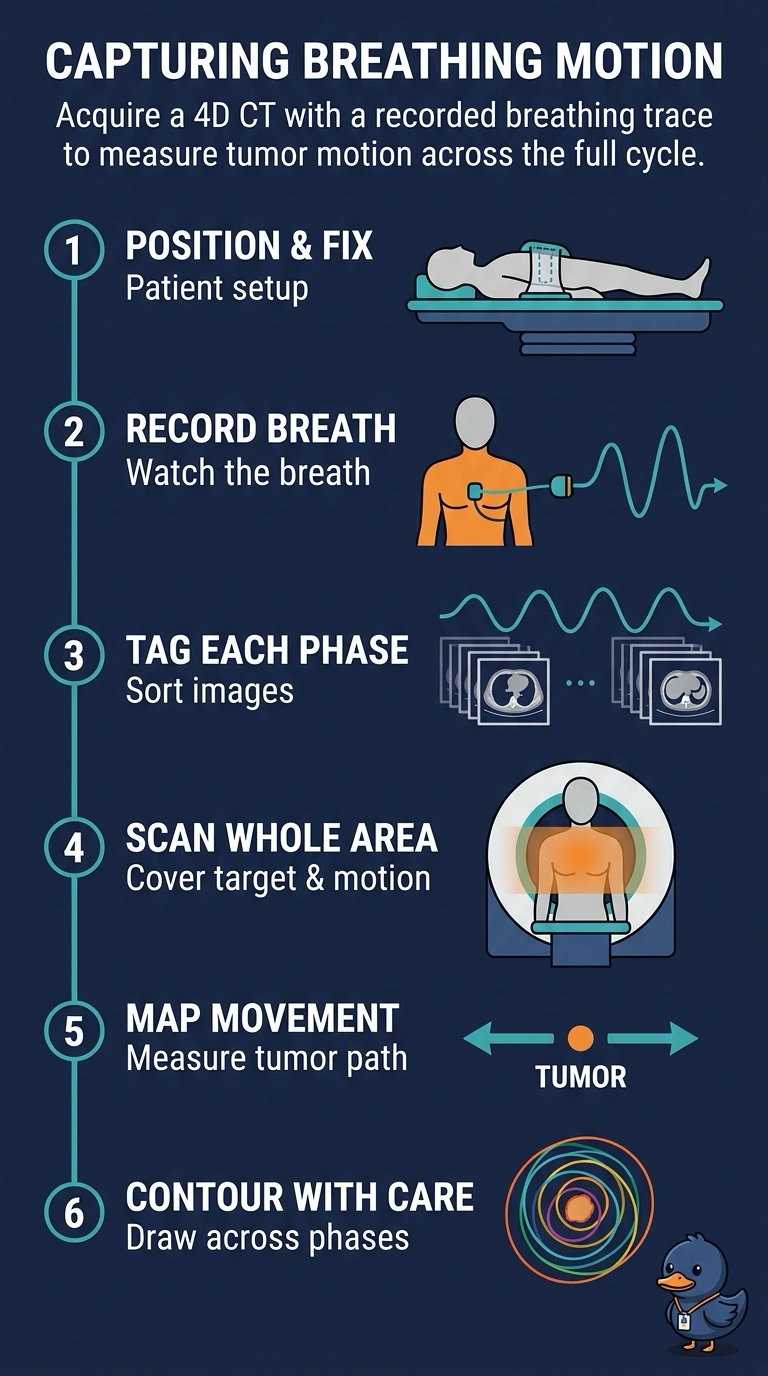
That lesion never sits still, and one snapshot can't show you where it travels. A 4D scan tags every image to the breathing trace, so the full excursion lands inside the volume you contour. It's the difference between one frame of a jump and the whole arc, and that arc is your motion envelope.
Full Explanation
A 4D CT synchronized to a recorded breathing trace reconstructs images at multiple respiratory phases, allowing the lesion’s position to be assessed across the breathing cycle before contouring. This directly addresses the physicist’s need to capture the full motion extent; a single conventional CT may show only a motion-blurred or phase-dependent appearance. End-expiration respiratory gating is a legitimate way to reduce motion and obtain a reproducible image, but it samples one selected phase, not the full excursion. Paired inhale- and exhale breath-hold scans provide useful endpoint positions, yet they sample only two coached states; irregular quiet breathing can produce positions or trajectories not represented by those holds, so the full observed motion is not captured. A slow helical free-breathing scan is also commonly used and may average motion for planning, but the resulting blur does not reliably distinguish the lesion’s full boundaries across phases or measure its excursion. Exam caveat: 4D CT quality depends on regular breathing and accurate phase sorting, so a recorded trace does not guarantee a usable motion dataset. Practical check: review the breathing trace and phase images for artifacts, confirm that the lesion is visible throughout the reconstructed cycle, and verify the motion envelope before contouring.