
During a dosimetry review, a vault therapist tells her supervisor that she declared her pregnancy at 11 weeks of gestation. Her whole-body badge total for the year is 8 mSv, and the medical physicist asks the team to apply the correct fetal limit for the rest of the pregnancy. Which statement gives the correct NCRP-based dose limit for the fetus in this declared pregnancy?
Select an answer to reveal the explanation.
Short Explanation
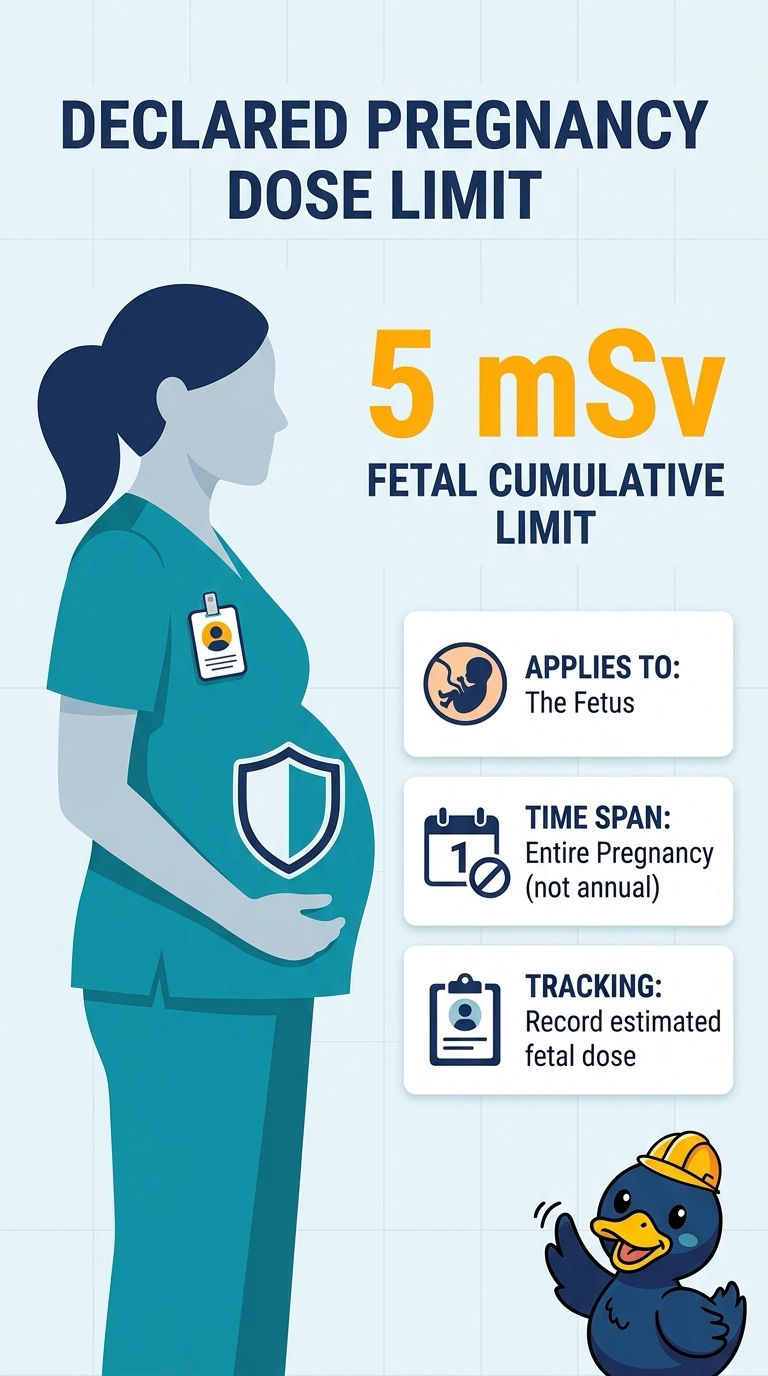
For a declared pregnancy, your fetus’s cumulative dose limit is 5 mSv for the entire pregnancy—not a yearly allowance that resets like a calendar. Since you declared at 11 weeks, that limit applies for the rest of your pregnancy.
Full Explanation
Under NCRP guidance, the dose to the embryo or fetus in a declared pregnancy should be limited to 5 mSv cumulatively over the entire pregnancy. This is a pregnancy-long fetal dose constraint: it does not reset at the calendar year, and it is separate from the worker’s own occupational dose limit. The 8 mSv whole-body badge total is the worker’s recorded dose for the year; it is not itself the fetal dose or a reason to replace the fetal limit, so fetal dose should be assessed and tracked for the pregnancy. The 1 mSv-per-year approach wrongly treats the fetal limit as an annual allowance rather than a cumulative pregnancy limit. Reducing the worker’s occupational limit to 1 mSv confuses fetal protection with the worker’s separate occupational limit; declaring pregnancy does not automatically change that limit. Applying the 50 mSv-per-year limit averaged over five years confuses the general occupational limit with the lower, pregnancy-specific fetal recommendation. Exam caveat: NCRP guidance is a recommendation, and applicable regulations or guidance in the relevant jurisdiction may differ. Practical check: document the pregnancy declaration, estimate and record fetal dose, and review its cumulative total throughout the pregnancy.