
A patient is simulated supine with both arms raised for a boost to a 1.4 cm supraclavicular target. The department's default planning CT uses 5 mm slices, and the radiation oncologist wants the target and its junction with the prior neck fields contoured on the same dataset. Which CT acquisition parameter should you adjust for this simulation?
Select an answer to reveal the explanation.
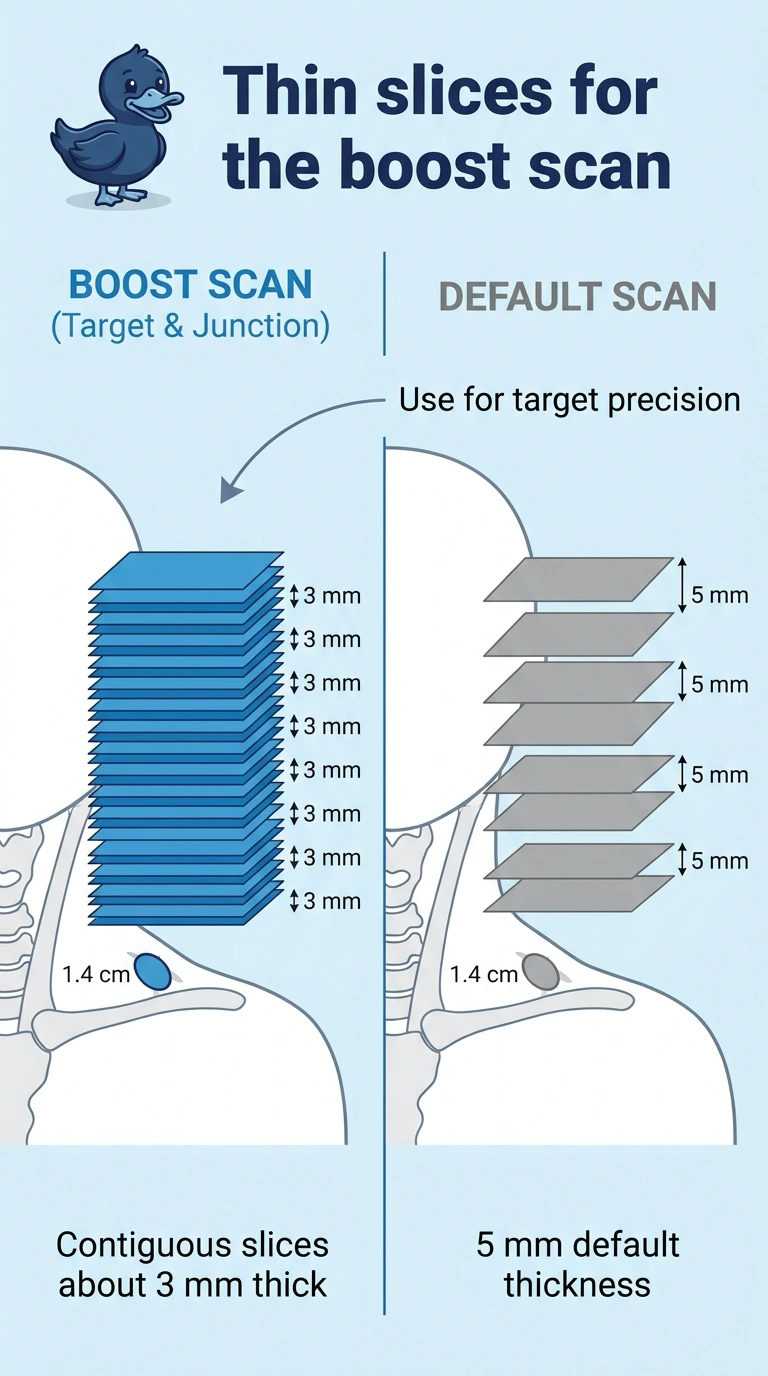
Short Explanation
Your target is only about three default slices thick, so the edges blur right where you'll need a clean match line. Thinner contiguous slices give the contour set the detail it needs to line up with the prior fields. It's the difference between a low-resolution snapshot and a crisp close-up.
Full Explanation
Slice thickness sets the finest detail a planning dataset can carry, and a 1.4 cm volume spans only three slabs at the routine thickness, so voxels along its edge mix target with surrounding tissue through the partial volume effect. The match with the prior neck fields raises the stakes, because a small shift against a thick slice can move the contour enough to create an overdose or a cold spot at the junction, while thin contiguous slices keep that boundary crisp inside one dataset. Raising tube current attacks image noise, which is a contrast resolution problem, and it never restores the spatial sampling that a small volume and a sharp junction demand. Widening the field of view solves coverage of the shoulders and external contour, which supports setup checks and dose calculation, but it spreads detector sampling across more area instead of adding slices. Giving intravenous contrast with a venous delay legitimately separates nodes from vessels for delineation, yet the slice interval stays coarse, so the contour still samples the same thick slabs. On the exam, remember that a small target or a field match steers the protocol toward thin contiguous slices rather than the routine body setting. A practical check before you leave the room is to scroll the stack at the junction and confirm the match line sits inside one thin slice with no gap or overlap.