
A patient with a lower-lobe lung tumor is simulated with a 4D CT for a motion-managed plan. On review, the breathing trace varies from cycle to cycle, and in several bins slices are missing across the tumor, which reaches the edge of the scanned volume at full inspiration. Which acquisition change best addresses both causes of incomplete respiratory bins on the repeat scan?
Select an answer to reveal the explanation.
Short Explanation
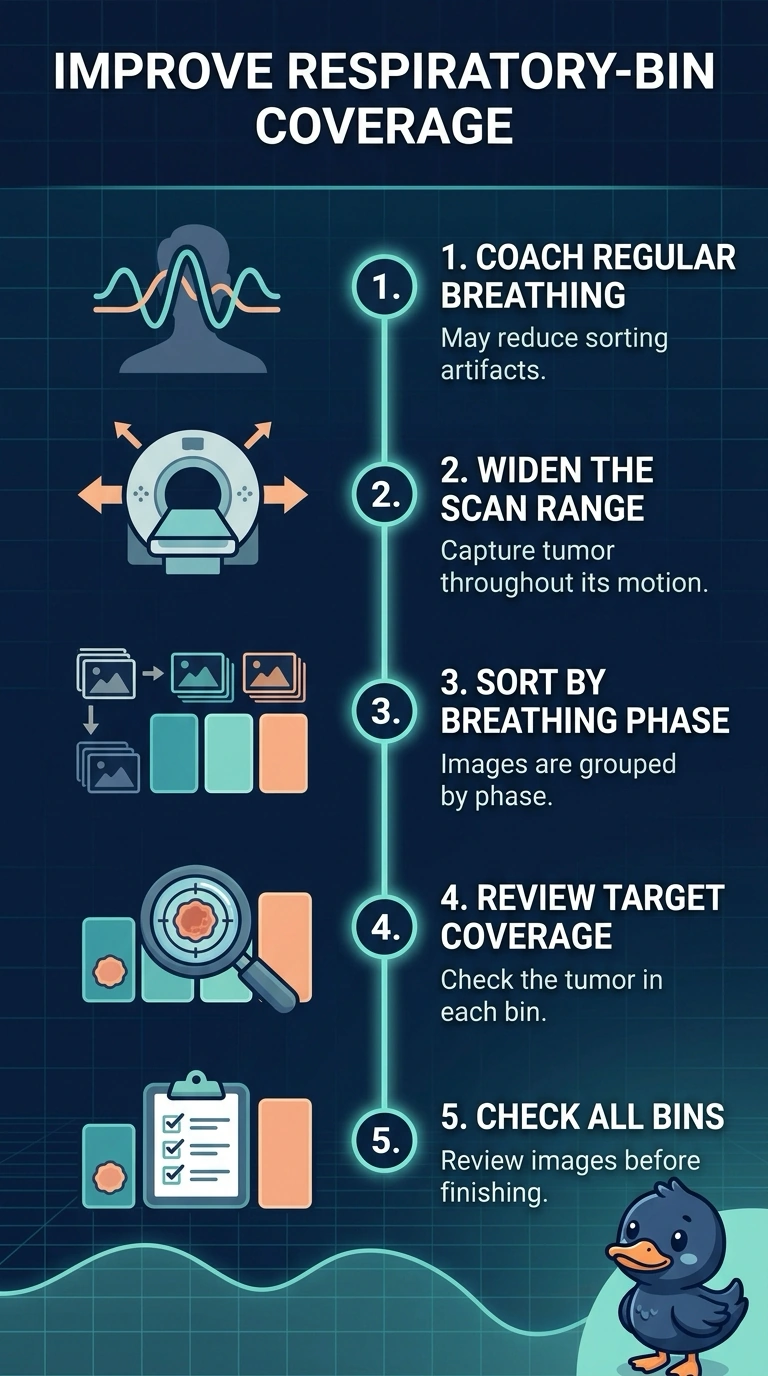
You’ve got two issues to fix: irregular breathing can scramble the 4D CT sorting, and the tumor moves beyond the scanned area at full inspiration. Coach steadier breathing and widen the scan range so, like widening a camera’s frame, the acquisition captures the tumor throughout its motion.
Full Explanation
A 4D CT uses a recorded breathing signal to sort images into respiratory bins. Cycle-to-cycle breathing variation can cause sorting artifacts and incomplete or distorted phase data; coaching for more regular breathing may improve the acquisition, though it cannot guarantee artifact-free bins. When the tumor reaches the edge of the scanned volume at full inspiration, some anatomy may not have been acquired, so the scan range should cover the tumor throughout its motion. Coaching alone does not address missing anatomy outside the scan range, and widening the range alone does not address breathing variation. A single breath-hold scan does not provide the respiratory-resolved images used to assess motion across the breathing cycle. Phase counts and sorting conventions vary between scanners, so assess the images in each bin rather than relying on the number of phases selected. Review the bins to confirm that the tumor remains within the imaged volume throughout its motion.