
A patient with a lung lesion that travels several centimeters with breathing is simulated for a stereotactic course; immobilization is set, the scanner can sort by respiratory phase, and the physician wants the motion characterized. Which CT acquisition approach best captures the target motion for planning?
Select an answer to reveal the explanation.
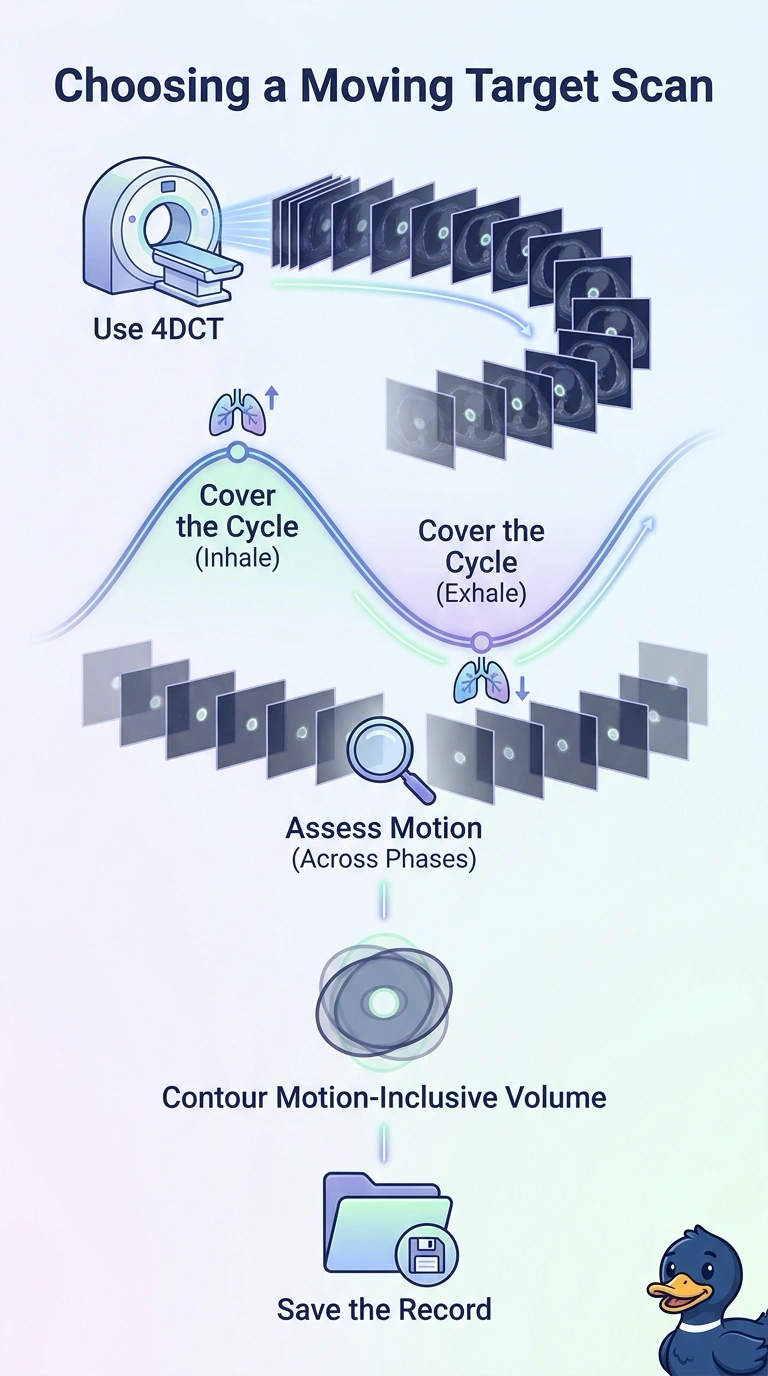
Short Explanation
A 4DCT captures the target at different points in your breathing cycle, like a flipbook showing how it moves. A single-phase scan gives you just one snapshot, so it won’t show the full motion.
Full Explanation
A respiratory-correlated 4DCT sorts images into phases across the breathing cycle, allowing the team to review how the lesion’s position and shape change over time and to derive a patient-specific motion envelope for planning. This directly addresses the request to characterize substantial respiratory motion, rather than merely obtaining a geometrically detailed image. Paired end-inhalation and end-exhalation breath-hold CTs are a reasonable way to sample the extremes of excursion, but they do not show the target’s path or behavior at intermediate points in the cycle; they therefore provide less complete motion characterization. A respiratory-gated CT at end expiration can produce a useful, relatively stable planning image, but it represents only the selected phase and cannot by itself establish the full motion range. A conventional free-breathing 3DCT is widely used for anatomical planning, but its image may average or blur motion and does not reliably separate the target’s positions by respiratory phase. Exam caveat: 4DCT is not automatically artifact-free; irregular breathing, phase-sorting errors, or very small targets can make the apparent motion misleading. Practical check: review the phase-resolved images and motion trace for completeness and consistency, and confirm that the observed excursion is plausible before defining the treatment target and margins.