
A student observing morning QA sees the accelerator's dose-monitor reading fall below tolerance while the CT simulator calibration, the light field, and the imaging panel all check out normally. Which accelerator component most directly supplies the signal behind this low reading?
Select an answer to reveal the explanation.
Short Explanation
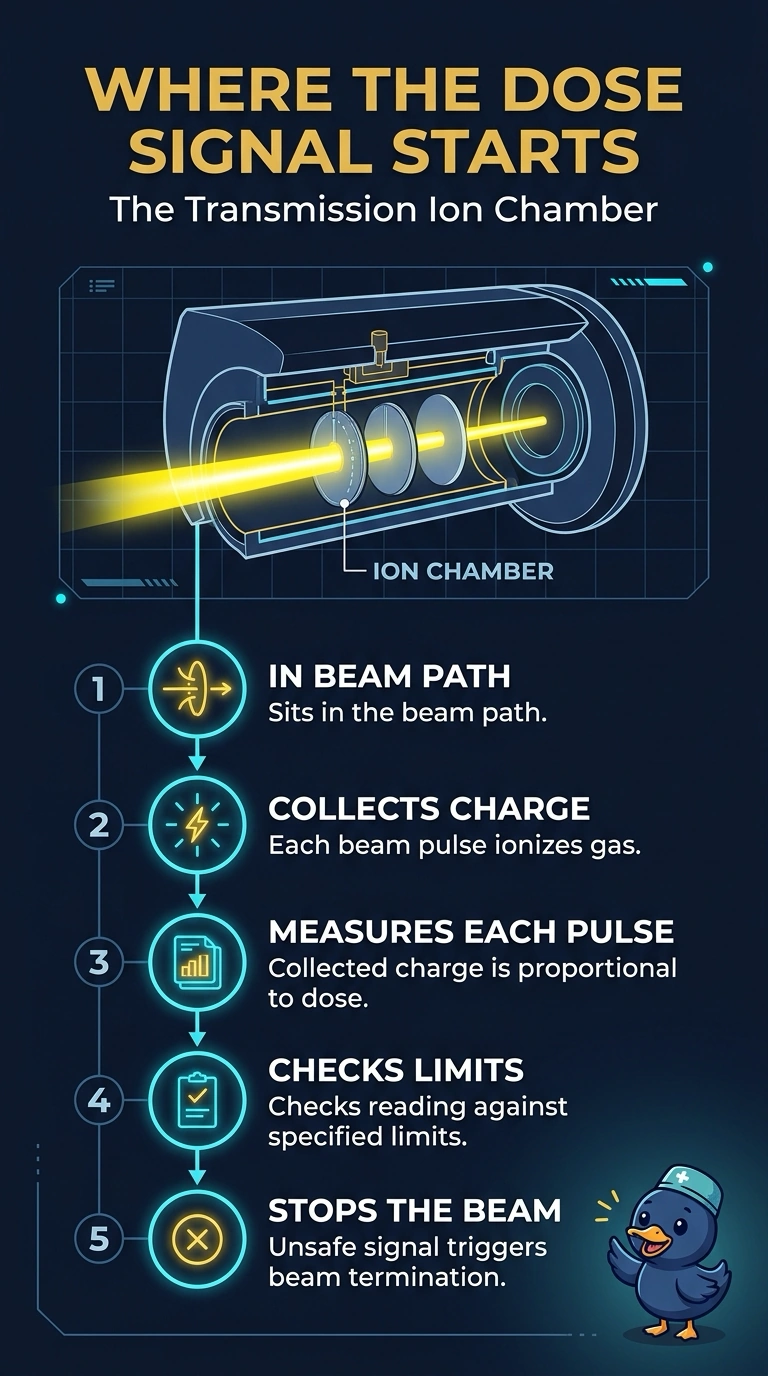
You can trace the low reading to the accelerator’s own dose-monitoring chain: the transmission ion chamber ionizes with each beam pulse and supplies the signal. The target produces photons, the multileaf collimator shapes the field, and the portal imaging panel records images, so none of those performs this monitoring job.
Full Explanation
The transmission ion chamber in the beam head supplies the accelerator’s pulse-by-pulse dose-monitoring signal. As the photon beam passes through the chamber, it ionizes the gas inside; the collected charge is proportional to the dose, allowing the accelerator to monitor output and respond if the signal moves beyond specified limits. The target does convert accelerated electrons into bremsstrahlung photons, but producing the beam is not the same as measuring its dose. The multileaf collimator defines the field shape with its leaves; it does not provide the primary output-monitoring signal. The portal imaging panel records images and is not the accelerator’s primary dose-monitoring chain. An exam caveat is that the monitor-chamber signal is distinct from an independent check of the accelerator’s actual output, so a low reading identifies a monitoring result rather than, by itself, the cause of the deviation. For a practical check, match each component to its role: the target produces photons, the transmission ion chamber measures dose, the multileaf collimator shapes the field, and the portal imaging panel records images.