
During a planning huddle for a chest wall boost, the team compares a 6 MV photon field with a 9 MeV electron field on the same patient. The photon curve falls off gradually with depth while the electron curve drops steeply after a shallow buildup and then reaches near zero. Which interaction explanation accounts for that difference in tissue?
Select an answer to reveal the explanation.
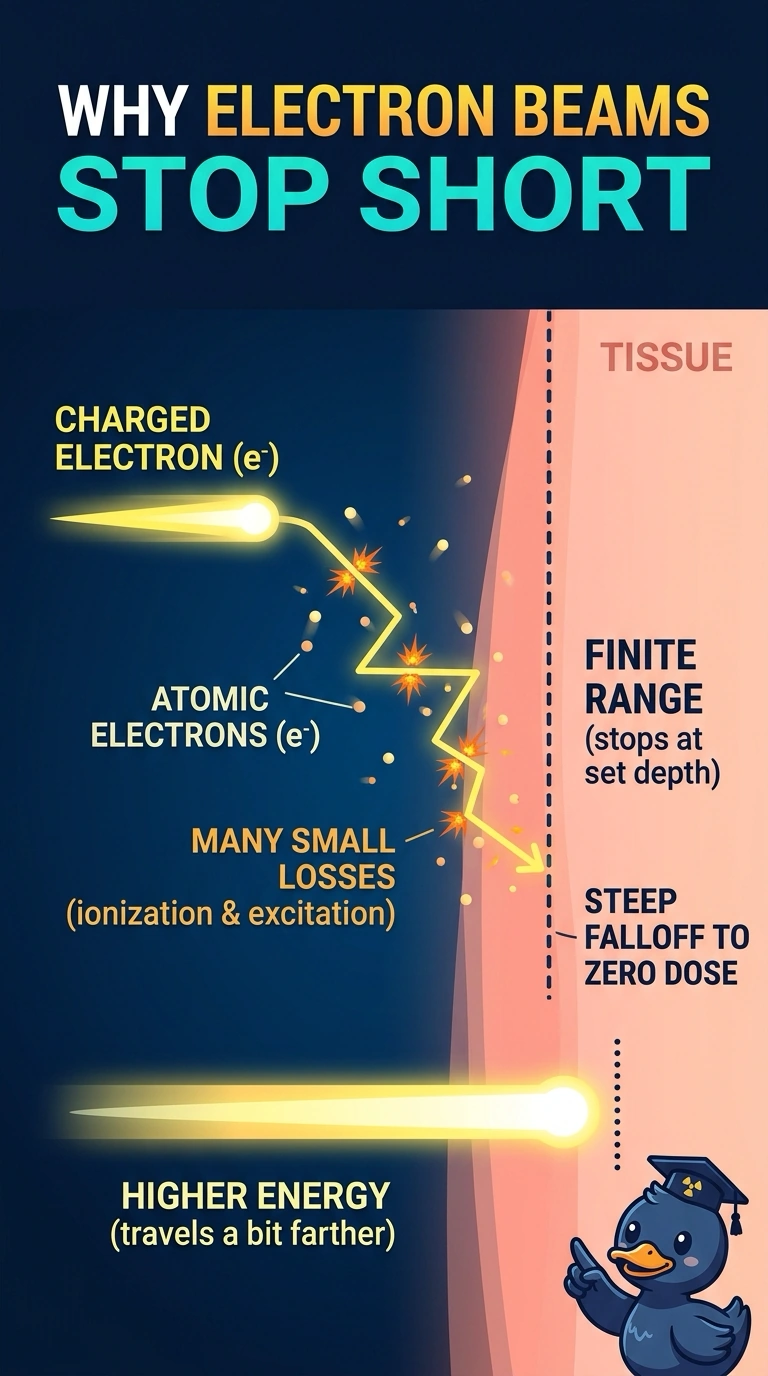
Short Explanation
Photons and electrons don't travel the same way through you, so their depth curves part ways quickly. Electrons are charged and spend their energy in thousands of tiny ionization steps until they run out, which is why they stop at a set depth. Photons instead keep scattering or being absorbed, so their dose fades gradually rather than ending abruptly.
Full Explanation
Photons are uncharged and interact only occasionally, so dose builds up, peaks and then falls off exponentially as the beam is attenuated through scattering and absorption events, mainly Compton scattering in the megavoltage range. Electrons are charged particles that interact continuously with atomic electrons, shedding energy through thousands of ionization and excitation events per centimeter until they run out of kinetic energy and stop, which produces a finite practical range and a steep distal falloff. Bremsstrahlung does occur when electrons decelerate near nuclei, but in soft tissue it accounts for only a small fraction of the energy lost, so it cannot explain the sharp cutoff. Lateral scatter near the applicator edge shapes the penumbra and can modestly shift the apparent range, yet field size does not determine where the beam stops. Applying a photon depth law to an electron beam ignores the collisional nature of charged-particle energy loss. Exam caveat: these questions usually hinge on whether the particle carries charge. Practical check: confirm beam energy and applicator size, then read depth from the published curve for that combination.