
Before a planning MRI, a patient reports a medication patch on the upper arm, a stainless steel clip from an operation two years ago with the implant card available, and a grinding injury to the eye with no imaging on file. Which pre-scan hazard checks must be finished before this patient enters the MRI room?
Select an answer to reveal the explanation.
Short Explanation
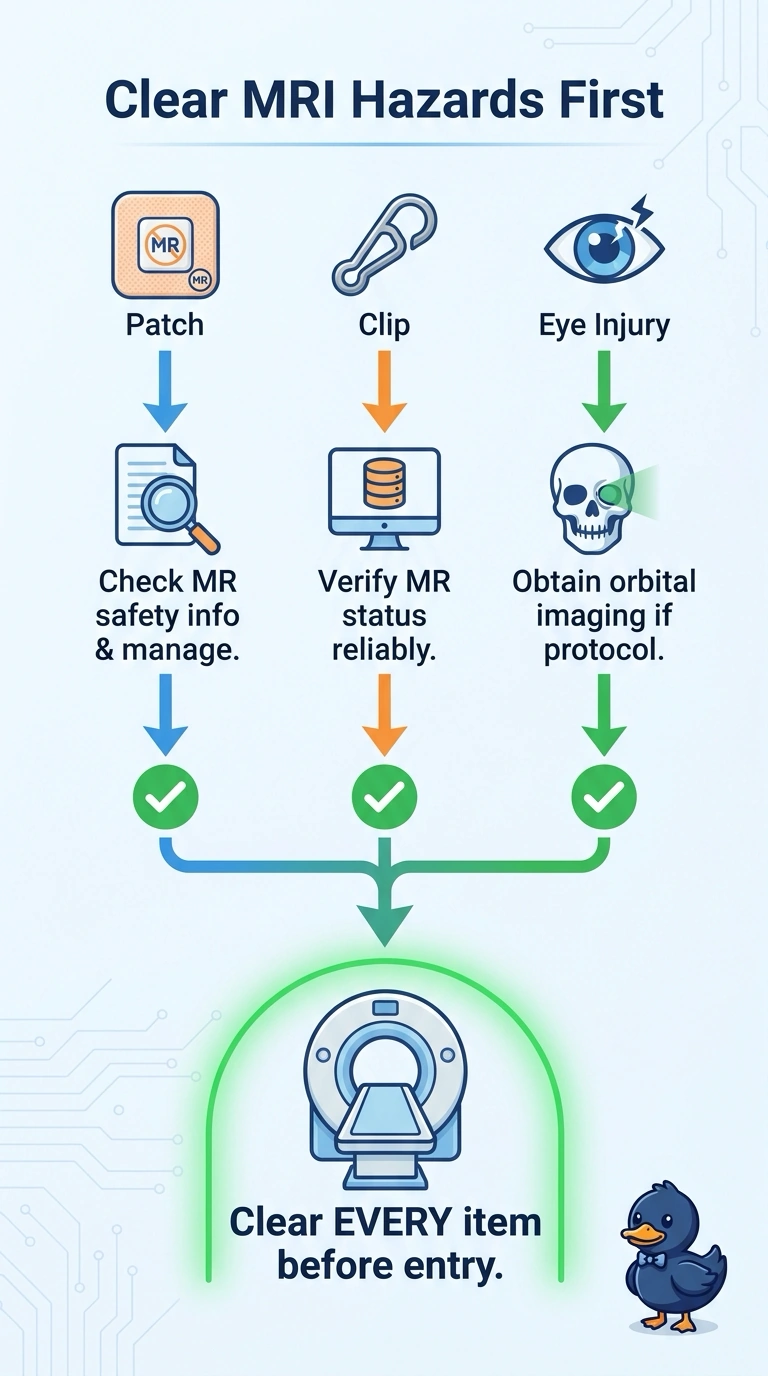
Before you enter the MRI room, treat these as three separate safety checks: review the patch’s MR safety information and manage it accordingly, verify the clip’s status using reliable device information, and obtain orbital imaging for the eye injury. Your vision can seem unchanged while a metal fragment is still present, so complete each clearance check before the scan.
Full Explanation
The safe plan completes all three independent checks before room entry: review the medication patch’s specific MR safety information and manage it accordingly, verify the clip’s MR status using reliable device information, and obtain orbital imaging for the possible retained fragment from the grinding injury. Normal vision does not rule out a small intraocular or orbital fragment, and an unverified clip cannot be cleared by a general material description. A history review and focused eye examination with imaging only if symptoms or examination findings suggest a fragment is insufficient here: no imaging is on file, and an examination cannot exclude a small retained fragment after grinding. Removing the patch and arranging replacement without first checking its MR safety information also fails, because product-specific MR instructions and medication-management requirements must be known. Checking the patch and obtaining orbital imaging, but clearing the clip from its stainless-steel description and an uneventful prior surgery, is likewise inadequate; neither establishes the clip’s MR status or any conditions for scanning. Exam caveat: “stainless steel” is not a blanket indication of MR safety, and an asymptomatic eye does not exclude a fragment. Practical check: match the exact patch and clip identifiers to authoritative MR safety information, and confirm the required orbital imaging and its result before entry.