
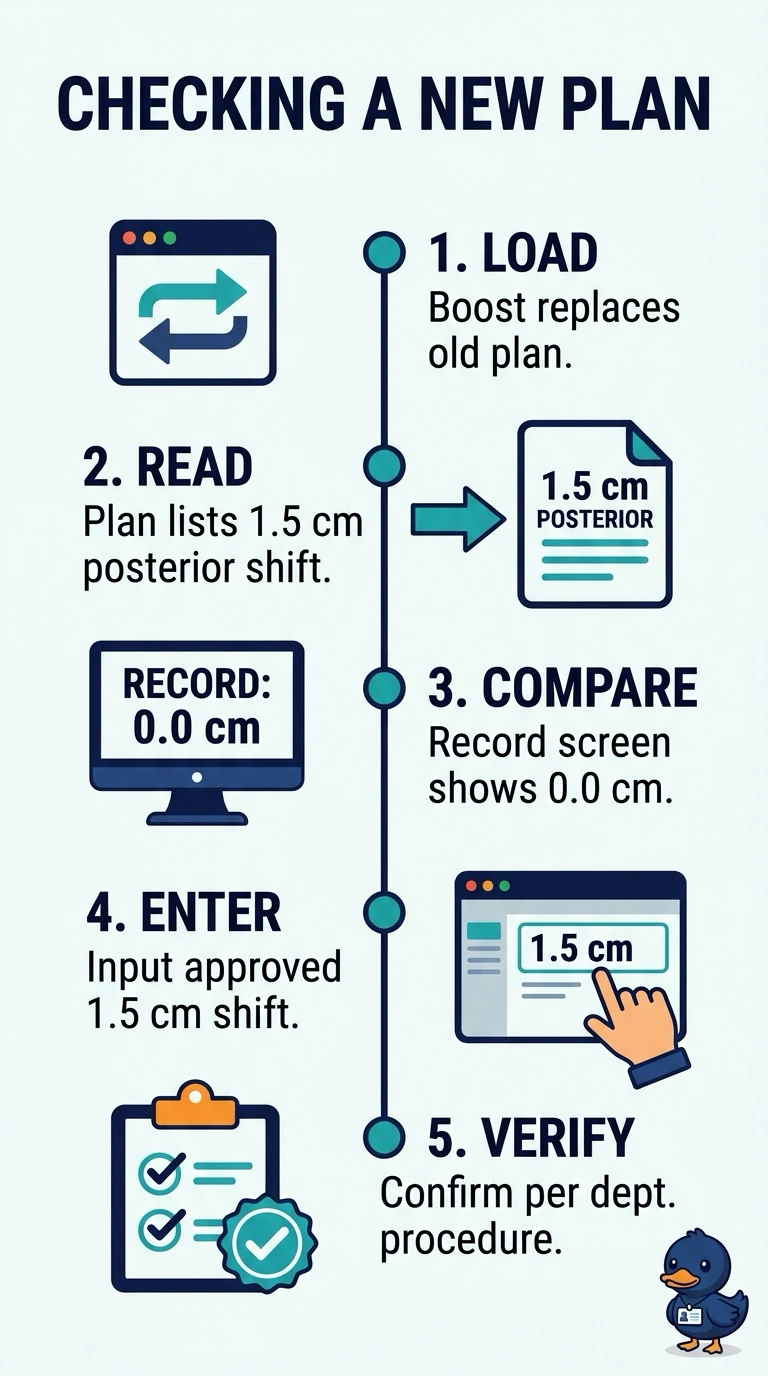
A boost plan is approved for a patient whose machine, immobilization device, and prescription are unchanged from the original course. The approved plan calls for a posterior isocenter shift of 1.5 cm, while the treatment record still shows a shift value of 0.0 cm. Which setup parameter must be entered and verified against the approved plan before the first boost fraction?
Select an answer to reveal the explanation.
Short Explanation
Your boost plan calls for a 1.5 cm posterior isocenter shift, but the treatment record still says 0.0 cm. Before the first fraction, enter and verify the shift against the approved plan—like checking a route change before you set off.
Full Explanation
The boost plan explicitly changes the isocenter by 1.5 cm posteriorly, so that setup parameter must be entered and checked against the approved plan before treatment begins. Unchanged equipment, immobilization, and prescription do not cancel a plan-specific geometric change; leaving the record at 0.0 cm would fail to implement the approved boost geometry. Retaining the original isocenter and deriving a correction from image guidance substitutes a measured daily match for the fixed, approved plan shift. Image guidance can support patient positioning, but it does not authorize changing the planned isocenter. Applying the 1.5 cm as a couch translation instead of entering the isocenter shift uses a different setup control and may produce a different or duplicated displacement if both are applied. An anterior shift has the right magnitude and parameter type but reverses the specified direction. Exam caveat: posterior/anterior signs can vary with the machine or treatment-planning coordinate convention, so do not infer direction from a plus or minus sign alone. As a practical check, compare the boost plan, treatment record, and console coordinates, confirm the intended posterior direction in the local convention, and complete the required independent setup verification before the first fraction.