
At the initial planning conference, the team describes a patient with lymphoma involving nodal chains in the neck and around the abdominal aorta, a liver biopsy free of disease, and extranodal sites uninvolved. Which staging designation correctly classifies this patient's disease?
Select an answer to reveal the explanation.
Short Explanation
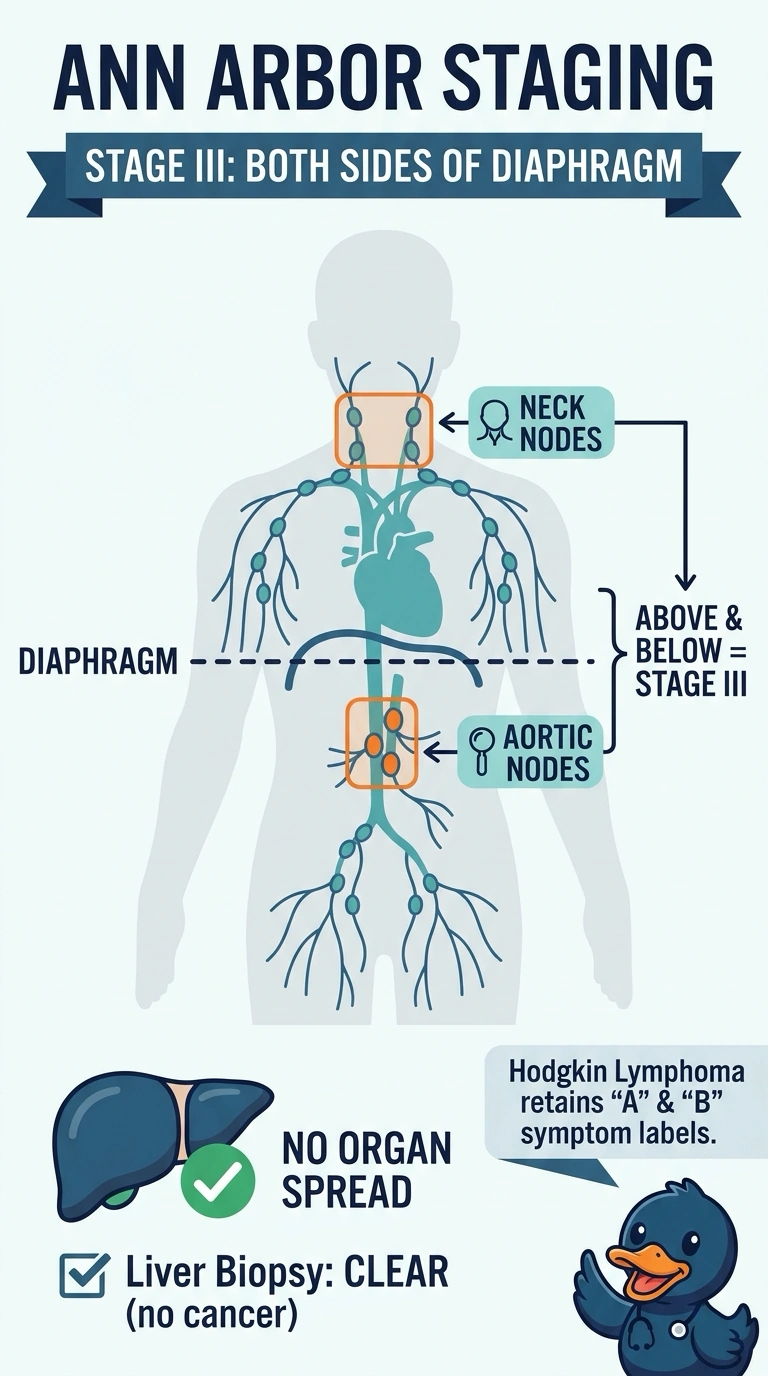
The Ann Arbor system maps lymphoma by where it’s found: nodes above and below the diaphragm, like stops on both sides of a border, mean stage III. Your patient has no organ or other extranodal spread, so this isn’t stage IV.
Full Explanation
The correct designation is Ann Arbor stage III: this system stages lymphoma by the anatomic distribution of involved nodal regions, and neck nodes lie above the diaphragm while para-aortic nodes lie below it. Nodal disease on both sides of the diaphragm therefore meets the stage III definition. Ann Arbor stage IV is the disseminated extranodal-organ approach; it does not follow merely from disease above and below the diaphragm. Here, the negative liver biopsy and absence of other extranodal involvement provide no evidence for stage IV. Ann Arbor stage II is the same-side-of-the-diaphragm approach: it covers multiple nodal regions confined to one side, so it cannot classify this patient's distribution. TNM is the primary-tumor, regional-node, and distant-metastasis framework used mainly for solid tumors, not the standard system for lymphoma; counting two nodal regions and assigning stage IIB is therefore conceptually inappropriate. Exam caveat: current Lugano recommendations use the Ann Arbor framework, with A/B symptom designations retained for Hodgkin lymphoma. Practical check: mark each involved nodal site relative to the diaphragm, then assess for extranodal organ involvement before distinguishing stage III from stage IV.