
During a physics in-service, a resident reviews how a 6 MV photon beam loses intensity as it passes through soft tissue. Which statement about the dominant photon interaction and attenuation is correct?
Select an answer to reveal the explanation.
Short Explanation
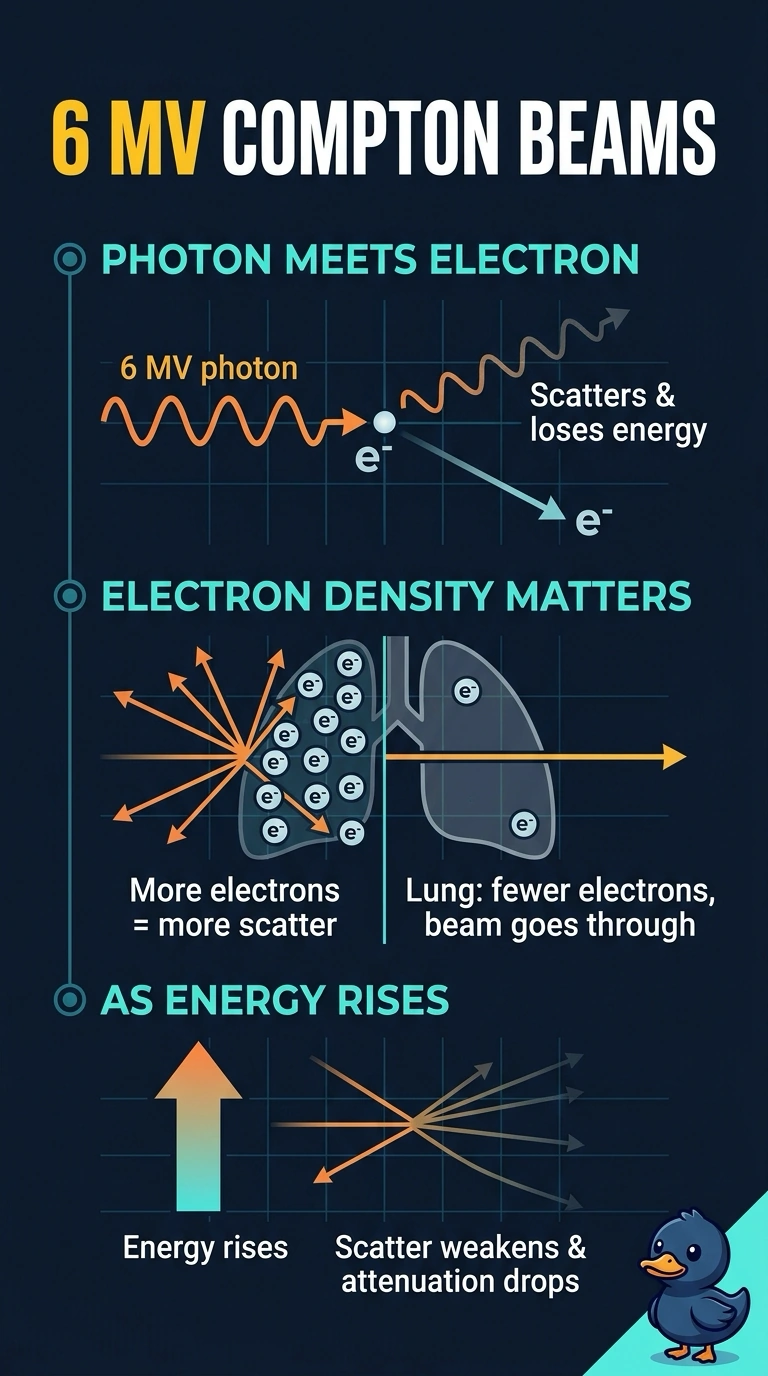
At megavoltage energies, Compton scattering is the workhorse, so the beam mostly depends on how many electrons are in the way. Like bumper cars, it's the count of them and not the paint color that matters. That makes electron density the quantity you're tracking in a 6 MV beam.
Full Explanation
At 6 MV, Compton scattering is the dominant interaction, in which an incoming photon is deflected by an electron and gives up part of its energy to that electron. Because the probability of that interaction depends on how many electrons are available and falls as photon energy rises, attenuation tracks electron density. Treatment-planning systems commonly use relative electron density in heterogeneity corrections. Photoelectric absorption is not the megavoltage explanation because its probability drops steeply with rising energy and depends strongly on atomic number, so it is more important at lower energies and in higher-Z materials. Pair production is possible above its threshold, but it does not dominate in soft tissue for a clinical 6 MV beam. For attenuation questions, first identify the dominant interaction at the beam energy in soft tissue, then consider what that interaction depends on.