
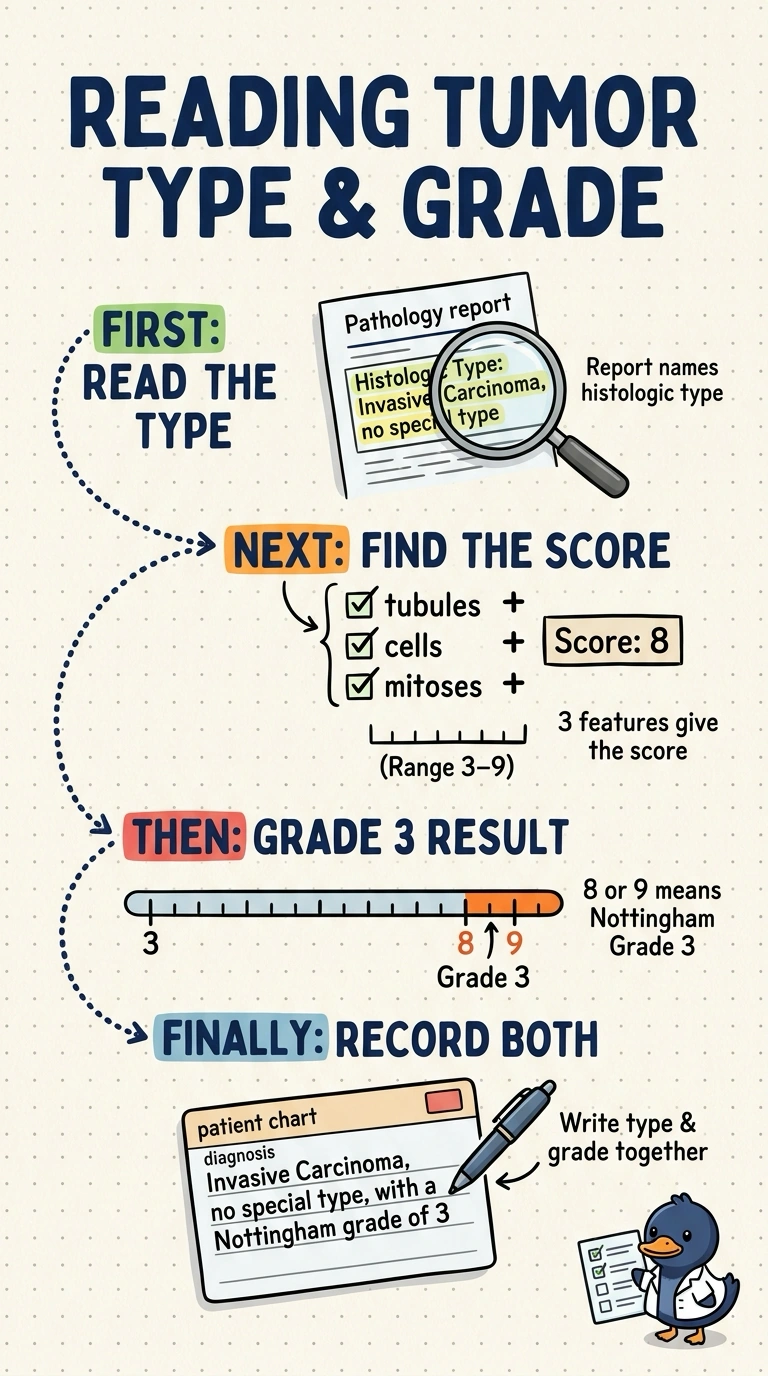
A breast core biopsy reports invasive ductal carcinoma with tubule formation under 25 percent, marked nuclear variation, and a high mitotic count, giving a combined Nottingham score of 8 out of 9. Which histopathologic type and grade should be entered in the record that the treatment plan references?
Select an answer to reveal the explanation.
Short Explanation
Nice work — you read the pattern and the score as two separate answers. A total of eight or nine maps to grade 3 in the Nottingham system, the least differentiated category. The other entries each drop one fact the pathologist already handed you.
Full Explanation
Nottingham grading is a fixed recipe: tubule formation, nuclear pleomorphism, and mitotic activity are each scored and summed, and a total of eight or nine maps to grade three, while the histologic type comes from the morphology the pathologist describes, which here is invasive carcinoma of no special type. Recording the score as grade two is a rounding approach that ignores the published band the total falls into. Naming invasive lobular carcinoma is a pattern-recognition approach that swaps in a different architecture the report never described. Deferring the grade to excision is a conservative reporting approach that is reasonable only when a biopsy gives no scoring features, which is not the case when a full score is already supplied. On the exam, type and grade are two separate fields drawn straight from the pathology report, so they are never merged into a single impression. In practice, copy the type and numeric score as issued, then confirm the mapped grade with the physician before the chart is closed.